A Quiet Trade
The fire was low, and the air in the Toad and Lantern smelled of damp reed thatch and long-boiled roots. No one paid much mind to Lowen — they were always alone, usually busy with something in their hands: a bottle, a file, a twist of wire. Tonight it was nothing. Just stillness, and a tankard they hadn’t touched.
Una sat near the hearth, nursing something sharp-smelling and brown. Her coat was patched but clean. She’d lost weight since last season. Her mouth still worked when she chewed, but she winced sometimes after.
Lowen waited until she glanced their way. Then rose, slow, with nothing urgent in their step. They brought no questions. Just a pouch.
They settled a little down from her, nodded once.
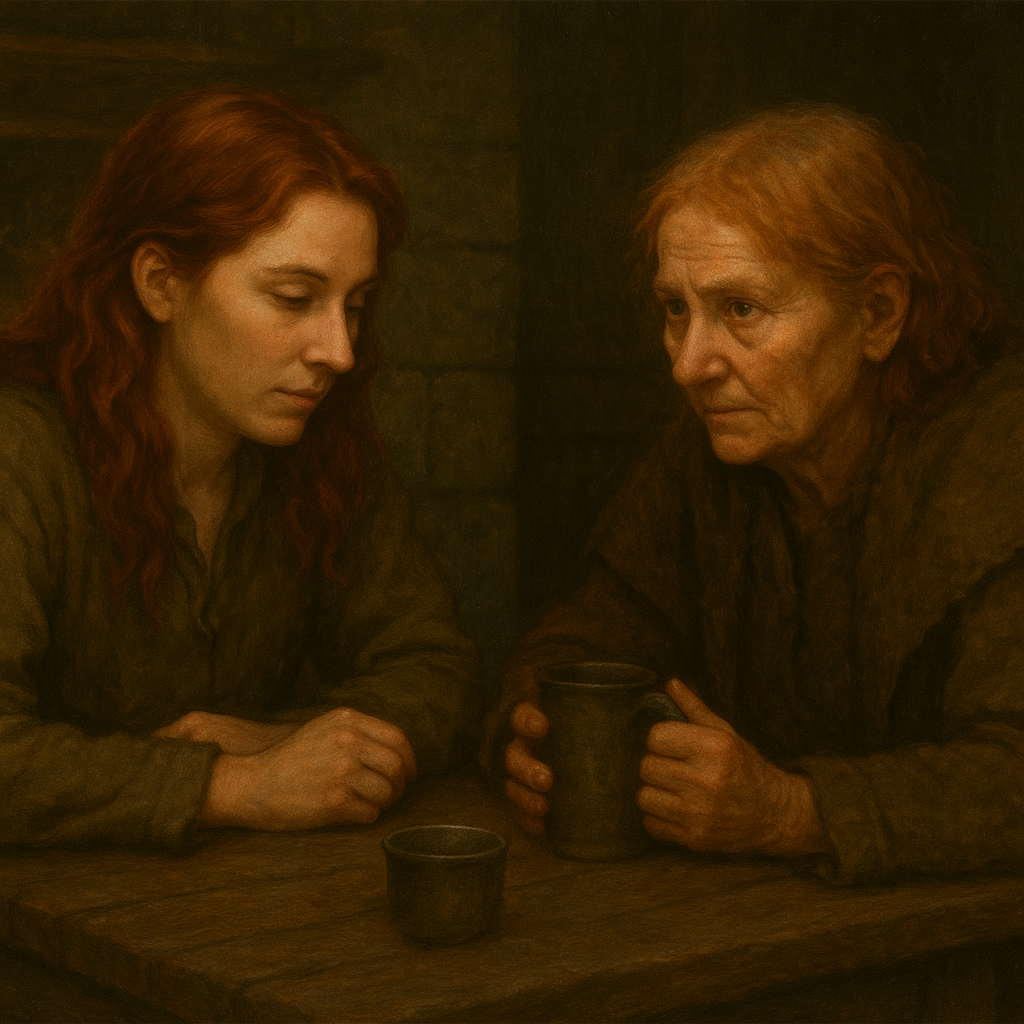
“Leg giving you nettle?” they asked mildly.
“Don’t take nothing for it. Just rest when it bites.” Una replied.
Lowen opened the pouch and placed a small jar on the table. Something green-gold sloshed inside. Una eyed it.
“For the joints,” they said. “Just pressed. Smells strong but settles warm.”
Una leaned forward, sniffed. Then, suspicious, leaned back.
“What do you want?”
Lowen folded the pouch closed and tucked it away. “Nothing. I passed you up by Mard Lane once, in spring. You looked like your hand was shaking.”
Una’s fingers were still wrapped tight round her cup.
Lowen waited. Then added, as if idly:
“Heard they’re shoring up the bank past Bracken Copse.”
Una didn’t respond.
“They say it’s slipping.”
Still nothing.
“Usually it’s brushwood and stone for that, not rods.”
Una’s mouth twitched. Not quite a smile. “It’s not our business.”
“No,” Lowen said. “But it’s not theirs either.”
A silence. The fire cracked.
Then Una said: “There’s no signage. No crest. No charter notice. Just lads with tools who don’t answer questions.”
Lowen nodded. “Local?”
“Mostly. Not all.”
Another pause.
Lowen stood, slid the jar a little closer, but didn’t push it.
“Yours if you want it. I won’t offer twice.”
Una looked into their eyes and seemed to weigh them with her own. Resolved, she began to talk.
“Streambed’s full of ghost-stone, but no one calls it that any more.” A bitter smile. “Not since the boys from Bricklin bought up the land and fenced it off for safety.”
She took a sip. Lowen remained silent. “Safety from what, I wonder,” Una uttered gruffly. “It’s not locals doing the measuring.”
A beat. Then quieter:
“Not unless they’ve started wearing Evergild boots without the sigil.”
Lowen tilted her head.
“They’re not mining yet,” Una added. “But they’re marking the slope like they plan to.” A flicker of unease. “The last place they fenced, we lost the spring. No warning. Just gone dry.”
Lowen offered no thanks. Just a steady look, and a nod—not of debt, but of recognition. One listener to another.
When they stepped outside, the night was thick with river mist. The path home ran through silence.
The Marked Slope
Two days later later, Lowen returned to the dry streambed just past first light. The mist sat low, clinging to roots and old bracken. No workers. No flags that day. Just the hush of early frost and the faint sound of blackbirds shifting in the hedge.
They followed the bank until they found it—just beyond where the cordons had stopped: a badger set, half-collapsed, the earth around it littered with flakes of pale, striped stone. The ground had cracked there, subtly, exposing a seam. Ghost-stone, Una had called it. Soft, cloudy and banded like bone and smoke. Lowen picked up three pieces; one hummed in their palm like a half-heard note.
The Mason
Lowen watched for two nights before they spoke to him.
Devlin wasn’t hard to spot—broad hands like barked timber, voice low but always speaking, even when no one replied. He drank steady, not quick. Wore the kind of apron that left a pale shadow on his clothes when removed.
The Axe and Pick sat just uphill from the main coppice lanes, its eaves hung with split logs and a wheel of antlers someone had carved half into a sun. It was mostly coppicers in by dark, their talk muddy with sawdust and frost-crack. But Devlin drank with the stonefolk—quarrymen, roughmasons, two who’d laid the base of the new causeway.
Lowen came with a small pouch and a clay bottle—nothing strong, just something warming, with fennel and hawthorn in it. They waited until he stepped out to check his pipe. Then followed.
“Clean cut on that signstone in the yard,” Lowen said, casually. “Your work?”
Devlin looked over. “Suppose so. Don’t usually sign things.”
Lowen nodded. Drew out the pouch. “Got a small job. Needs to be true, not pretty.”
Devlin raised an eyebrow. “Work that fits in a pouch, eh?”
Lowen said nothing, just unwrapped a single chunk of ghost-stone. It caught the lamplight, showing banded greys and a faint green that shone like a moon behind clouds. Not precious—but unmistakably not common.
Devlin frowned. “That’s a fine bit of calcite. Where’d you dig that?”
“Didn’t dig,” Lowen said. “Found. It’s old. It’s ours.”
“Yours, meaning…?”
Lowen looked at him for a long beat. “I want to set it. But it needs the right shape, and a quiet file.”
“You want me to jewel it?” Devlin huffed. “I set hearthstones, not lockets.”
“You cut curves,” Lowen said softly. “And you don’t ask questions you don’t need answers to.”
That hung in the cold air for a while. Then Devlin took the flint, turned it in his hand, whistled low.
“What’s it for?”
“A marker. A gift.”
“Risky,” he muttered.
Lowen nodded. “That’s why I came here.”
Devlin looked back through the open door of the pub. Inside, someone shouted something about ash poles and the whole room laughed.
He turned back and handed the flint over once more. “Two days. I’ll round it and smooth the back. You get your silver ready.”
“I already have.”
Devlin grunted, shook his pipe, and went back in. Lowen stayed in the dark a little longer, breathing in the bark-smoke and the half-frozen air.
Work at Dusk
The calcite returned to them in six pieces; two were ovalled, clean-edged, and soft-sheened like river glass. The other four were small irregular shards polished smooth.
From the ovals, Lowen cast two heavy silver pendants, the stone set proud at the centre. Around each stone, a single arc of silver wire crossed part of the surface—curved just enough to trace the shape of the streambank. Not exact, but those who knew the land would recognise the line. They’d shaped it with care—set not for show, but for place.
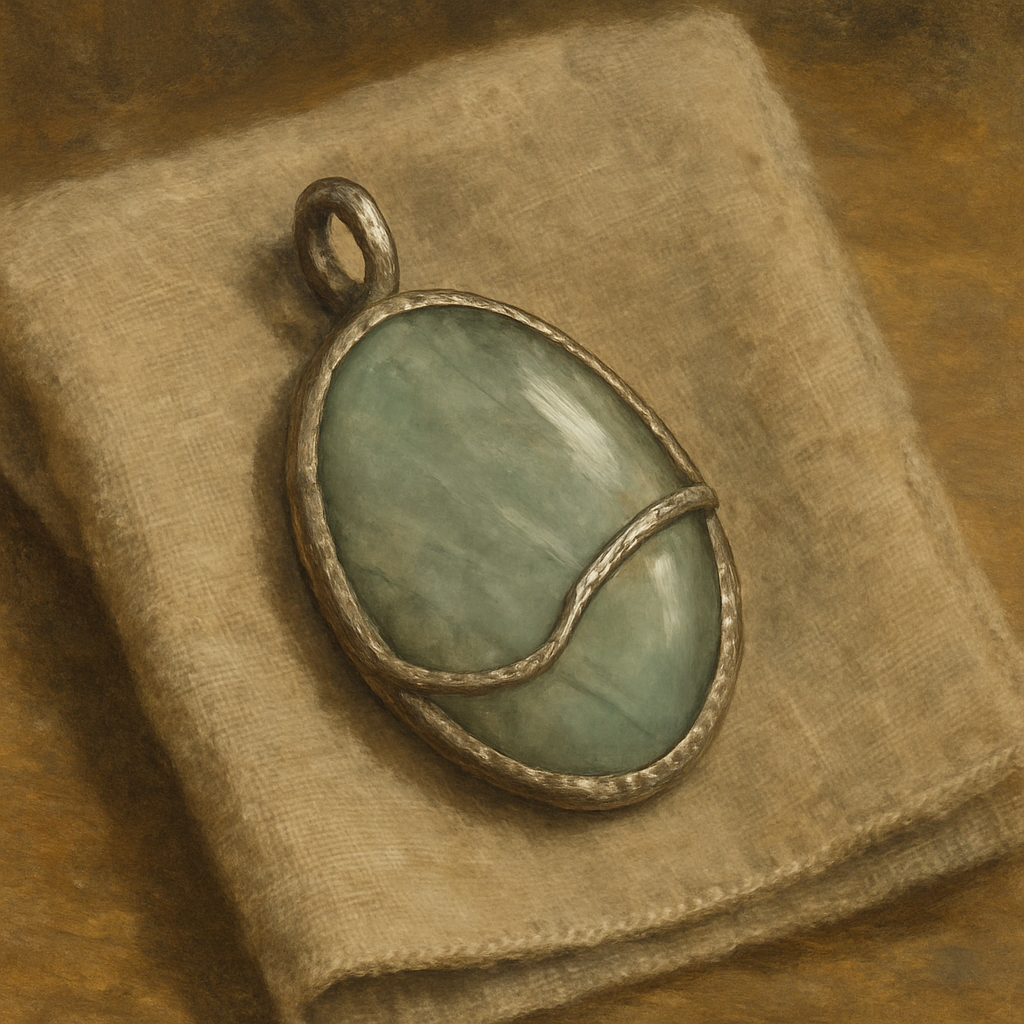
The smaller stones they set into simple silver rings. They kept one aside, meaning to give it to Una. But didn’t—yet. It stayed wrapped in linen in the pouch with their other quiet things.
They brought one to Devlin, quietly.
A silver ring, simply made—an oval of ghost-stone set low, a wire curl tucked beneath like a stream’s bend. No explanation. Just laid beside his mug at the Axe and Pick.
He turned it in his fingers, then slipped it on.
“It fits,” was all he said.
By the Quarry Pool
Lowen waited until the next Crumble Top market day, knowing Brannoch would be there. The Stoneward didn’t move much—his responsibility was to the standing stones that peppered the plateau; ancient markers and sacred circles. He lived close to the stones. Not guarded, but watchful. The kind of presence the land seemed to settle around.
Lowen caught sight of Brannoch just once in the market square—a quiet silhouette near the edge of the stalls, speaking briefly with the knife-grinder. He wore fine wool, slate-coloured and heavy, with a clasp the shape of a thistle bloom. No crest. Just detail. His presence passed like a ripple—noticed, but not approached.
Lowen didn’t follow right away. They watched which path he took off Kiln Green, then waited a while, long enough for the crowd to fill back in. Then they slipped out the same way, walking light, the wrapped pendant tucked into their belt pouch.
They found him above the old quarry pool, where the stone had long since been pulled and the rain left behind. The water was deep and still, rimmed in green. Bracken and fern pushed in from all sides. Brannoch sat on a flat rock, boots planted, elbows on his knees, looking at the far bank like it might speak.
He didn’t look surprised when Lowen approached. Just turned slightly, enough to show he’d heard.
Lowen stepped forward, slow but steady, and held out the bundle. A twist of wool, wrapped in twine.
Brannoch took it. Unfolded it carefully. Inside lay the pendant. He turned it once in his hand. The ghost-stone did not glint in the light. It never did.

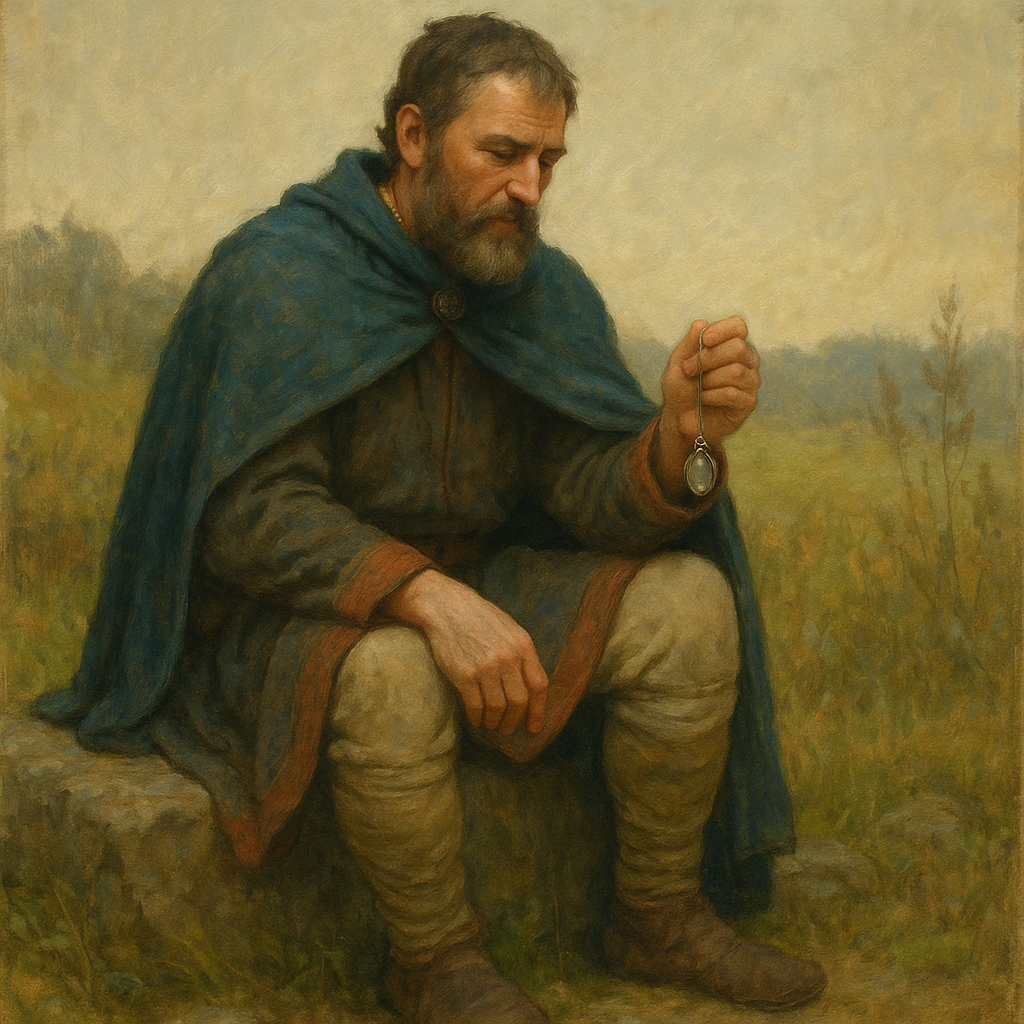
Lowen spoke, voice quiet.
“From the ridge. Just above Bracken Copse.”
Brannoch looked down at the stone again.
“That ground’s not sacred.”
“No,” Lowen said. “But it listens.”
Brannoch didn’t answer. He placed a hand to the silver pendant, and gave a nod that felt heavier than thanks.
Lowen stayed there, standing in the ferns. Hesitating, they added softly:
“I’d like to stand beside what you guard. When it’s time.”
Brannoch looked up at them for a long moment. Not weighing. Just present.
Then he gave a slow nod, nothing grand. A gesture like stone turning slightly underfoot. The quarry held the silence.
Lowen walked back to the market, feeling the lightness of having given the pendant to what seemed like its rightful owner. Something eased in their chest. It wasn’t quite kinship. Not yet. But it was no longer nothing.