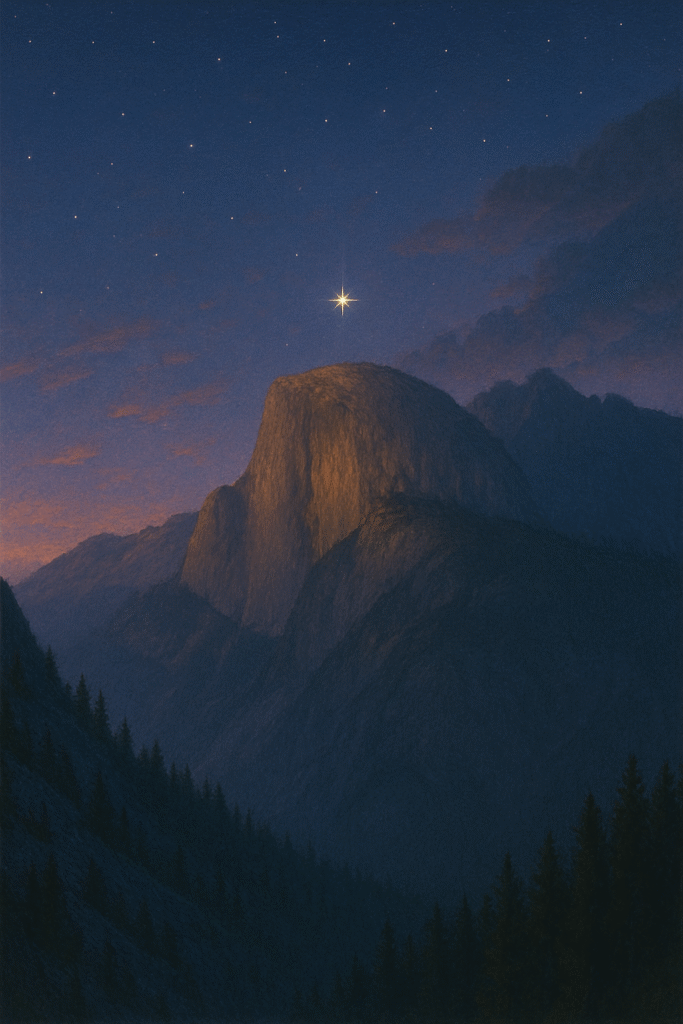
The Reel
The clan had clustered since dusk, voices looping like wind in a hollow. Three men spoke over one another, their breath clouding in the fire-smoke, each sure of what the sky had said.
“Fancy a star of a thousand ages changing its mind in our lifetime,” Tarran muttered. “No—it’s the mountain that shifted.”
Someone nearby laughed, thinking him joking; he wasn’t.
The Reel turned. Now a woman was claiming the skies had turned entire, and mankind with them. Tarran rankled, yet kept his thought to himself this time—Aye, and you said the constellations mirrored when your third was born, yet the stars stayed right where they were.
A low chime from the old bowl marked the next rotation. Tarran joined the tribe as they reshuffled in a complexity that was second nature to them. The smoke was thick by this fire. He sniffed, scowled. Burnt hair. Some fool had fed plait-ends into the tinder again. It stank of impatience and indelicacy.
On and on wound the Reel: arguments smoothing into repetition, sparks lifting, falling. Balance found its own weight. As he tired, Tarran leaned back on one hand and gazed at a thin cloud as it slowly scudded across the star on Karn’s peak, sheared by a high wind though on the ground the air was still.
A few days later, three Vythans arrived:
One said the spring water below has shifted—softer mineral content, changed course.
Another tracked animal movement—small mammals fleeing high grounds, seasonal patterns off.
One saw a rockfall that revealed an old carving—worn, but unmistakably Morna.
The Morna don’t welcome them, exactly. But they don’t hide, either, and in serious matters respect an open discussion with others who share their values. They didn’t repeat the Reel for the Vythans’ benefit, but held a counsel, open to all. The elders presided in a loose ring, faces lit from below, while the rest pressed close enough to listen, if not to speak.
Shelda stood among her band, brow heavy as she tried to find footing in the swirl of arguments. The Morna spoke in ways true to themselves—deep, deliberate, slow to yield. Each phrase felt quarried rather than said. She was used to the Vythans’ quicker exchanges, theory bouncing like flint sparks; this was more like tectonic drift.
A grey-bearded seer was still talking of the heavens, of constellations shifting and fate bending. Shelda was fighting a yawn when another of the gathered Morna broke in.
“Now you make a fair point,” said a dark-haired man from the far side of the fire, his voice calm but edged. “But has anyone thought what happens if the ridge itself moves? Because it’s not going to hold steady without proper thought.”
The remark drew both scowls and murmurs of agreement. Shelda straightened a little, studying him. Broad-shouldered, weathered, eyes like wet granite—solid, critical, unamused. He looked like a man who trusted rock more than sky.
When the seer tried to answer, he only shook his head, muttering something about “putting the stars to bed and facing facts.”
Shelda grinned faintly to herself. A practical one, she thought. And probably a right pain to everyone else.
The Workshop
He saw her coming before he heard her—stride firm, passing him in his summer workshop and standing facing the ridge.
“What are you doing?” Tarran called, sharper than he meant. Outsider, up on his ground.
Without looking round, Shelda replied, “Your lintel’s soon to crack.”
“Already did.”
She came closer, squinting at the beam. No crack.
He jabbed a finger along the right edge. “Fixed it.”
She tilted her head, gave a short approving grunt. “Eh.” Then, after a beat: “How’s your roofing?”
“What about it?”
“Won’t last the season. The slope’s moving. You’ll want your tools clear before it does.”
Before the Winter Descent
Talks of the Telling had gone round in circles for weeks. The Vythans and Morna alike had picked the prophecy apart, compared notes, drawn marks in earth, and found nothing new for their trouble. The wind had changed, that was all, and the days were shrinking. Winter was sliding down the ridges.
Tarran felt it in his bones. His people were already gathering their tools and sealing their caches, the year’s work nearly done. The Vythans were preparing to head for Valmorren, down where the air was soft and the springs ran hot. They’d done what they could together. Time to part ways.
Shelda found him at the edge of the camp, where he’d been securing a stack of timber for the descent.
“We Vythans, we move about, you know,” she said, half-smiling.
“So do we.”
“Aye. We’re heading down the slopes for the winter—Valmorren.” She grinned gleefully. “Hot springs. Sometimes they bubble,” she added with a wink.
He gave a short, humourless snort and kept working, fingers gliding to create his signature knot. She watched him a moment, weighing silence against risk.
Then, factually, with a hint of challenge, “I’m not going.”
He looked up, frowning. “What do you mean, you’re not going?”
“I’m not going.” Softer this time, but sure.
The wind stirred between them, carrying the smell of cold granite.
“I’m not interested in women,” he said flatly, busying himself with his pack.
“I’m more than woman, lad—you must’ve noticed,” Shelda said, amused that he, older by a decade, still needed telling.
He tilted his head slightly, half a nod.
“You don’t have to be interested,” she reasoned. “Hardly think the rocks are interested in me either, but they keep their shape when I’m done talking. They give my echo back when I call—and that’s more than I can say for most folk.”
Tarran looked at her then, and noticed for the first time the depth in her grey eyes. He only half heard her add, “We’ve all our hollows, but they don’t have to stay empty.”
She hesitated—uncharacteristic for her. “You can touch me, you know. I don’t disappear.”
He froze, suspicion flaring. “Why would you say that?”
“You look at me like I’ve gone already. Like I’m a shadow far away.”
He looked down, shame and grief mixing. She stepped closer, took his hand, and pressed it briefly to her chest — heartbeat solid, steady — then placed his hand back. He stayed close, still looking down, the air thick with the unspoken.
The hammer at her belt clinked as she turned away. “See you at the descent, Tarran.”
He watched her go, the air around him feeling newly unsettled, like stone before a crack.
The Winter Walk
The High Morna were already moving. Packs strapped, tools wrapped in hide, the air sharp with the smell of wool and pine pitch. The long descent to their winter ground had begun.
Shelda walked with them now—slow, steady, eyes always straying to the rocks. The elders had agreed she could stay the season, a trial of sorts. No one said as much to her face, but she knew it. Every footstep felt like a measure being taken.
She barked the odd joke as they went, and more than one Morna was caught smirking before they remembered themselves. Even Tarran couldn’t quite hide his grin when she called to him from behind, “You lot walk like loose slate—no wonder the ridges crack.”
By midday the mist thickened, and the line of walkers stretched thin along the slope. Shelda fell behind again, crouching now and then to pry at a stone or lift a sheet of moss. The Morna kept their pace, glancing sideways but saying nothing.
Tarran felt it before he noticed: the space where she should have been. The air seemed wider without her voice in it. He turned, heard the faint tink-tink-tink of a hammer enjoying itself, and muttered, “She must have bones of iron. The rocks can’t help but pull her in.”
When he found her she was on all fours, tools spread like a small shrine before her, tapping delicately at a ridge of granite veined with pale colour.
“Better find a nice cloth pouch, love,” she said without looking up.
The word love jolted him—he froze, uncertain, until she went on, mistaking his silence for surprise at what she’d uncovered.
“Yes, it really is. I knew this ridge had a secret.” She prised a small crystal loose and held it to the light; it gleamed soft blue, the colour of cold sky through water.
Tarran staggered a step back. It would fit in his palm, no more, yet it was than he’d seen of such stone in his life—blue topaz.
Shelda grinned, eyes bright. “Reckon your lot’ll have me now,” she said, brushing the dust from her knees. Then, to the rock itself, almost fondly: “And what a lot you’ve got to give, you cheeky beauty.”
The rest of the group were humming with excitement at the discovery, the elders warm with approval. “Quite the colour, hasn’t it?” said Shelda, understating the gravity of her find. It was rare enough to trade well, but rarer still for what it meant. She’d listened to their mountain and heard it answer. From then on, no one questioned her place among the Morna.
After the season’s preparations were dealt with — upkeep of the path down to the village for winter trade, repairs to their halls, stacking their firewood for the long freeze — Shelda found Tarran working alone, making adjustments to one of his tools. She was curious; he muttered something about “a hammer better suited to your sort of knocking.”
She found it bundled in cloth beside her one morning. Catching Tarran outside gathering wood, Shelda tested the weight of the new hammer, gave it a few solid swings against stone, and grinned. “Smooth as buttered shale. Next one, make the plating thicker—I’ll need it when I find a ridge that bites back.”
Tarran groaned, half proud, half exasperated. She winked, already turning to her work. By midday she’d told half the camp about her new hammer, and he’d caught himself smiling every time he heard it mentioned.
He never quite understood why she didn’t tire of him—but she never did, and her laughter still reached him like warmth from a forge.
The In-between
When the thaw came, Shelda packed light and left with the meltwater to rejoin her Vythan band. No farewell speech, no promise, just a nod to Tarran and a joke about checking the southern slopes before they fell apart.
By midsummer he was back at his workshop on Karn. The repairs from last year were sound; the improved roof, as Shelda had predicted, had held. He found her hammer-marks on the ridge above, a few chips knocked out where she’d been testing the stone. He touched them once, without thinking.
Cullag, his apprentice, saw and smirked. “Looks like she got the better of your ridge, master.”
Tarran only grunted.
Come first frost, she was back—striding into the winter ground as if she’d only stepped out for firewood. The elders gave their measured nods; Tarran just said, “Roof held,” and she answered, “I told you it would.”
And so it went. The following spring she left with the other Vythans, distant lands in her eye, pulling her like gravity down the steeps.
The mountain year sloped by. Around the fire with his kin, Tarran pretended not to notice the glances that fell in the gaps he’d once mortared with his words.
Autumn crept early that year. The Reels were quieter, the Telling spoken less often now—settled perhaps, or simply left to rest. The Morna were preparing once more for descent when the watchmen called down the valley: a traveller climbing toward them.
Shelda came into sight long before her voice reached them—smaller than he remembered, or maybe just carrying more weight. She didn’t slow until she reached him. Breathless, cheeks raw from wind, she leaned her hands on her knees and said between gasps, “Don’t start—yes, I know I’m early.”
He frowned. “What’s wrong?”
“Nothing’s wrong.” She straightened, pushing stray hair from her face. “I’m six months gone, that’s all.”
He blinked, trying to grasp her meaning.
She laughed at his silence. “Aye, that’s right. Looks like I didn’t leave the mountains empty-handed.”
The Birth
Winter snapped closed on Bratha, long nights giving way only to misty half-light. Shelda’s time came on a morning so cold the smoke from the halls froze halfway up the flue.
She stood for most of the labour—fists at her sides, jaw tight, muttering and moaning in equal turns. The other women urged her to lie down; she ignored them, groaning with the tension of rock before it splits, then threw a final yell out across the peaks. It echoed back in a dozen voices, the sound breaking a crust of shale somewhere higher on the slope.
When the rockfall’s rumble faded, her cries were replaced by the strong voice of her and Tarran’s son. They eased her down then. A helper pressed her shoulder, saying she’d need sewing.
Shelda laughed, sweat-slick and pale. “Ah, well, no wonder. I’ve just birthed Huthra.” The women around her smiled in surprise—half at her sudden wit, half at the truth of it.
Later she’d insist on the namesake, claiming the curve of his shoulders matched the great mountain’s flank. Tarran disagreed, as was his way, and reshaped it slightly into something with less jest, more dignity, and truer to Morna naming — Huthran. And so the name settled, half her laughter, half his pride.
The Quiet Seasons
On his first pilgrimage down the winter path, Huthran was bundled in wool strapped to Tarran’s back, his weight pulling Tarran’s shoulders forward. The steam of Tarran’s breath hung in the cold. Now and then he muttered, “Aye, you’re your mother’s weight, all right,” while Shelda trudged beside him with that knowing grin. It was a small moment, but one that already hinted at the size of Huthran’s place in the world.
Spring light warmed the patch of grass outside the workshop. Tarran bent over his work on a small tool, face set in focus, testing the balance with that careful twist of his wrist. Shelda was beside him, baby on her hip, checking his work with mock seriousness — “Hm. Handle’s sound. Shame about the maker.” He just huffed, but there was the ghost of a smile.
The clear yellow haze of dawn saw young Huthran padding out while his father worked. The boy was already big for his age, hair sleep-tousled, standing in the workshop doorway watching a bird hop from twig to twig. Shelda handed young Huthran one of her Tarran-crafted hammers. “Not for playing with now,” Tarran calls, protective over tool and son in equal measure. The boy lifts it without fuss and doesn’t drop it.