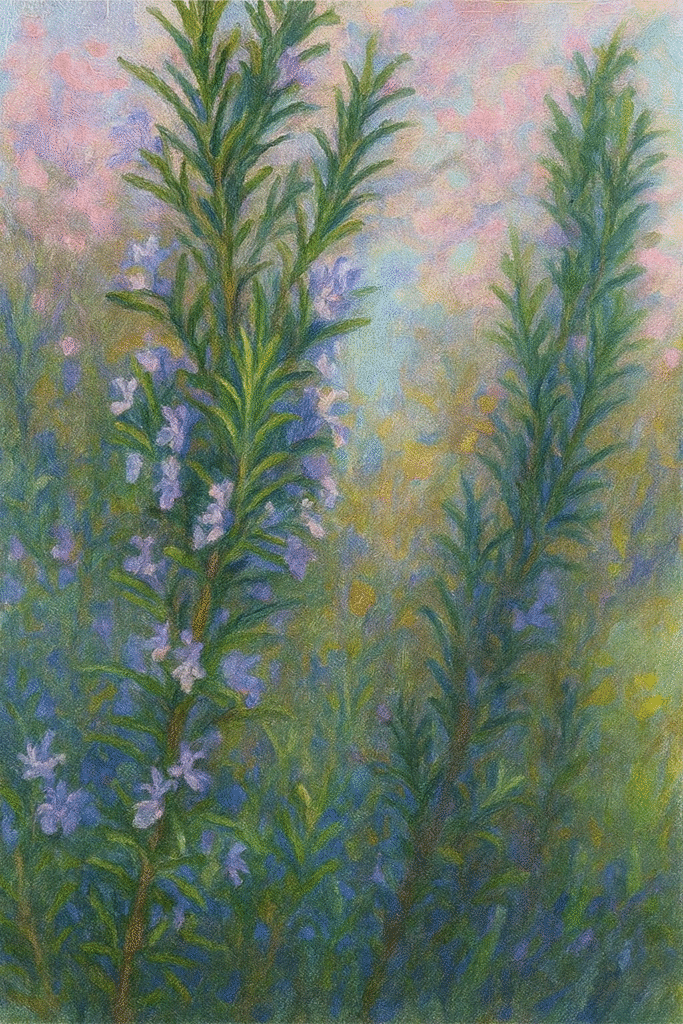
Chapter 1: Quiet Beginnings
Lowen Foss moved softly through the early morning mist, their footsteps muted on the leaf-covered path winding from their small cottage into the surrounding woodland. The trees stretched upwards, their branches interlaced like fingers protecting a secret, sunlight filtering gently to illuminate subtle shades of green and brown. Myrtle, a small wood mouse, peeked curiously from Lowen’s cloak pocket, whiskers twitching at the scents carried on the cool air.
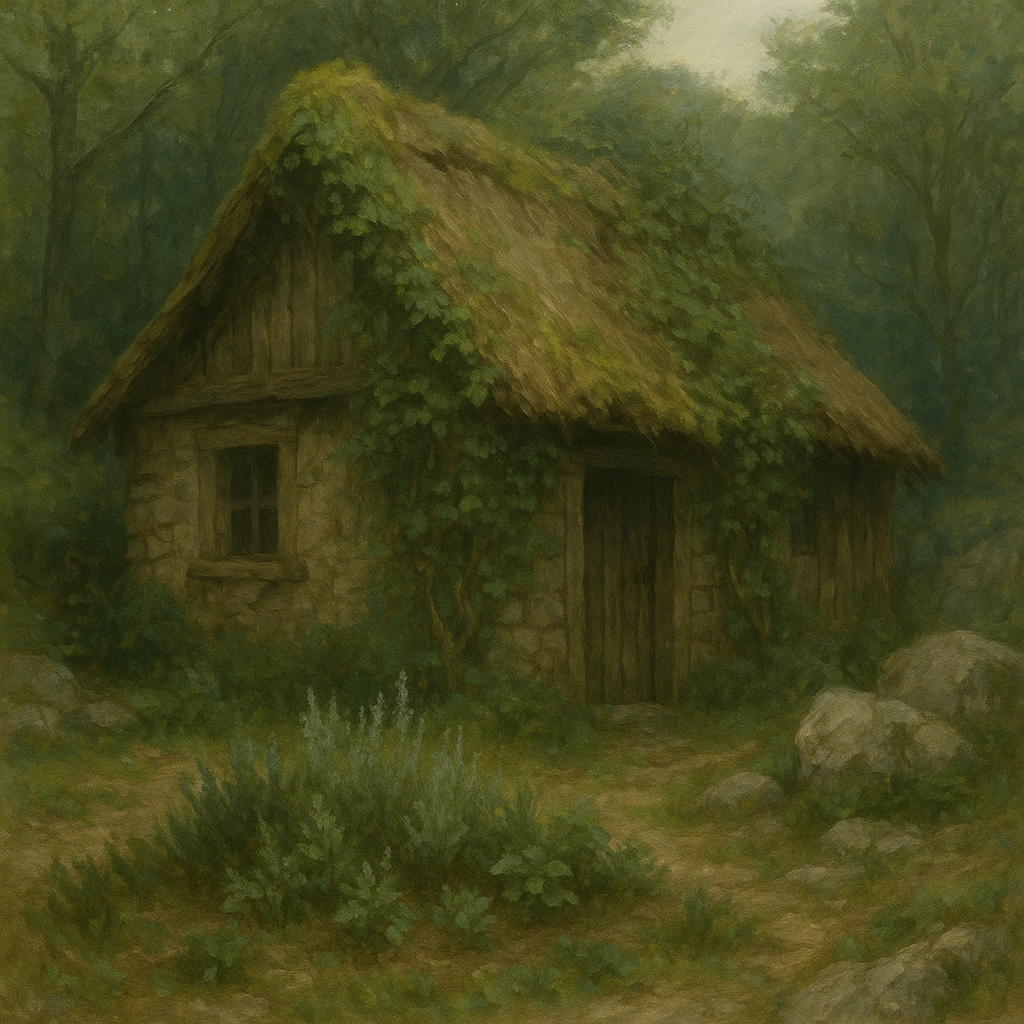
The cottage Lowen called home was humble, tucked away from well-trodden roads, nestled in a grove where ivy embraced walls of weathered wood. Inside, shelves brimmed with glass jars containing dried herbs and berries, meticulously labelled. Silver tools, polished but marked by years of use, rested beside delicate carvings waiting to be finished. Some of her father’s objects – herb preserving equipment, a simple wooden box, wrapped in oil cloth, a bundle of hand-drawn field notes and sketches — pressed between scraps of bark and vellum, tied with faded cord. Some are her own observations; others, written in Old Foss’s spare, looping hand, noting plant behaviour, moon phases, and quiet impressions of the land.
Lowen’s hands moved instinctively, gathering herbs with practiced care. Mint leaves, their scent crisp and invigorating, joined bundles of chamomile and lavender. They breathed deeply, feeling the quiet hum beneath their fingertips—a subtle resonance from the earth itself, guiding their selections.
Customers found Lowen rarely, always by quiet word-of-mouth. They sought gentle remedies and small comforts: a tincture to ease restless dreams, a pendant to soothe unspoken fears. Lowen crafted each piece deliberately, thoughtfully. They travelled from place to place, selling silverwork shaped under steady hands—charms, clasps, and pendants—and quietly tending to neighbours and passersby with tinctures and teas, using herbs they understood through practice more than study. The two crafts lived side by side at first, separate but companionable.
This morning, Lowen lingered at their workbench, fingers tracing the delicate veins of an ivy leaf carved meticulously from silver. Myrtle squeaked softly and ran across the bench as Lowen carefully fastened the charm onto a thin chain. The pendant felt alive, quiet but present. Lowen smiled faintly, satisfied but curious—always sensing there was more beneath the surface, some hidden potential not yet grasped.
Their quiet days blurred comfortably one into the next, punctuated occasionally by visits from familiar faces—traders, herbalists, and craftsfolk who offered stories as payment, whispers of the wider world beyond their quiet woodland home. Lowen listened, curiosity piqued but tempered by caution, aware they stood on the edges of deeper secrets.
By evening, they sat quietly beside the hearth, flames casting warm, flickering light over polished silver and drying herbs. Lowen’s thoughts drifted towards questions barely formed, wondering at the connections that lay hidden, waiting patiently to be found. They spoke to the sack where Myrtle was nestled in the folds, a few feet away.
“Tomorrow, we might stray past the old paths, little friend. See if the hum speaks louder there.”
Outside, twilight settled softly, cloaking the woodland paths in quiet darkness, the secrets of the fenlands whispering gently, just beyond reach.
Chapter 2: A Long Way to the Library
Lowen Foss stepped onto the winding road at dawn, their small hand cart packed carefully with their wares, silver tools, bundles of herbs, and modest provisions for the journey ahead. Myrtle poked her head out of Lowen’s cloak pocket, whiskers quivering with anticipation. The forest faded gradually behind them as the path unfurled ahead, leading toward the wider world beyond their sheltered grove.
Each day of the journey brought quiet discoveries. They exchanged crafted trinkets for fresh bread at a wayside village, traded herbs for honeycomb at a farmhouse, and received whispered stories in return—a healer’s new remedy, a trader’s tale of distant cities, murmurs of shifting fortunes among the noble houses. Lowen listened carefully, gathering pieces of a puzzle whose shape was still uncertain.
One evening, beneath the spreading branches of an old oak, Lowen sat beside their small fire, meticulously polishing a silver charm in the shape of a tiny leaf. Myrtle nibbled contentedly on crumbs of bread, ears twitching at distant sounds. The pendant seemed to hum faintly under Lowen’s fingers, resonating softly with the quiet of the twilight.
By the time Lowen reached the grand stone walls of the great Library, their load was lighter, but their heart heavier with questions. The sprawling building rose impressively from its manicured gardens, intricate stonework etched with vines and symbols from histories both remembered and forgotten.
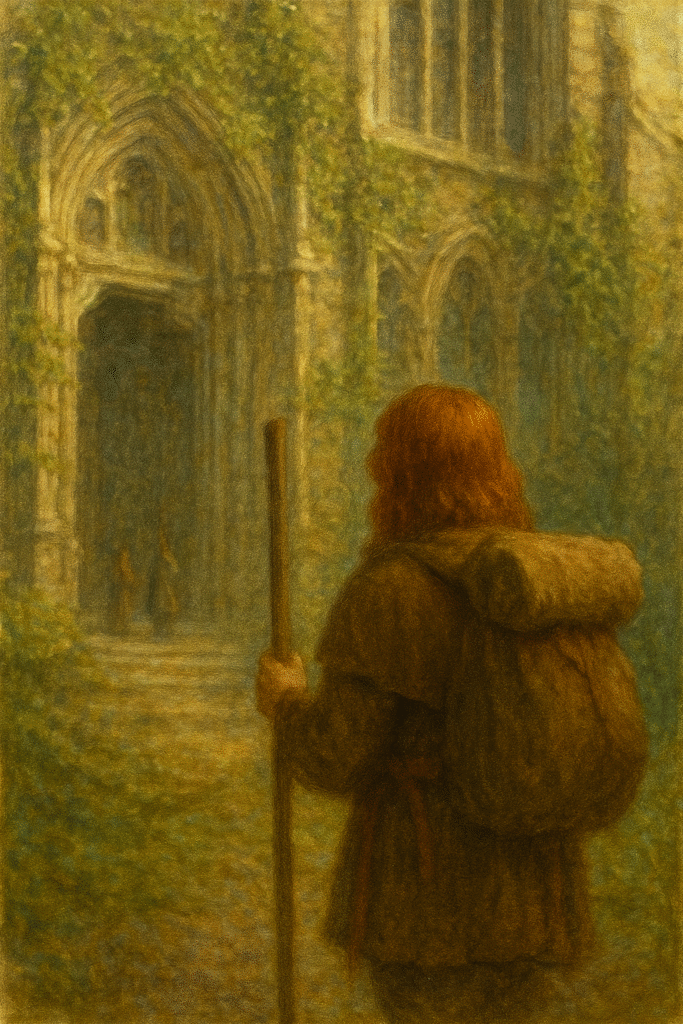
Inside, among the towering shelves of the frand Library, Lowen moved like a shadow — quiet, deliberate, almost invisible.
They had received temporary access on the recommendation of a passing trade official who’d admired their silverwork and remembered the name Foss. A week, no longer. Enough to browse, not to borrow. And only in the lower tiers — the deep halls and archival vaults remained forbidden.
That was fine by Lowen. They weren’t looking for secrets; not yet. Just confirmation of something they could already feel humming at the edges of their work.
By the third day, they had found the small alcove of plant lore and stayed there. Each morning, they settled with careful reverence among the cracked spines and stitched bindings. Myrtle disappeared between the shelves for hours at a time, returning with dusty whiskers and wide eyes.
Lowen copied fragments. Cross-referenced diagrams. Wondered about links between herbal uses and silver symbols used to bind or awaken. It was there, always there, but just out of reach.
They didn’t notice they were being watched until the sixth day. A fae appeared in their periphery like a sudden shaft of sun through mist. Their patchwork robes shimmered faintly as they leaned one hip against the edge of the reading table, head tilted with bright, curious intent.
“What draws you to this particular volume?” Aurenne asked quietly, genuine curiosity lighting their gaze.
Lowen looked up thoughtfully. “Feels like there’s more to these herbs than we understand. Layers we don’t see.”
Aurenne tilted their head, intrigued. “You’re not from one of the Houses, are you?”
Lowen smiled faintly. “Not from a House. Just passing through.”
They turned a page with care. A scattering of marigold petals had slipped from between the leaves, dried to translucent brown. Lowen brushed them aside gently.
“You read as someone who sees more than you speak,” Aurenne said, their voice a little softer. A pause. “It’s refreshing.”
They didn’t linger, nor explain further, but offered a courteous nod and drifted off into the maze of tomes, robes trailing like starlight.
Aurenne had already noticed the way Lowen’s satchel clinked faintly when set down — the sound of small metal objects in cloth. They’d seen a glint of wire-wrapped charms at Lowen’s wrist, the kind not bought in shops, but shaped by careful fingers.
And the book they pored over was no simple herbarium. It was Correspondences and Convergences: The Meeting of Matter and Meaning, a dry but rare volume that examined the resonance between natural materials and crafted forms — not popular reading unless you had a reason.
Aurenne put the pieces together easily. That was their gift.
Later that evening, after a private conversation with Gwynviène in the east reading chamber, Aurenne returned. Their expression was brighter now—mischievous, but almost reverent.
“There is someone here who thinks along similar lines,” they said simply. “Would you allow me to make an introduction?”
Lowen followed quietly, heart quickening slightly with anticipation, as the paths they’d quietly followed began converging toward deeper truths waiting patiently to be found.
Lowen followed Aurenne through winding corridors and quiet alcoves until they reached a small study tucked away from the busier areas of the library. The air here smelled of parchment, ink, and faint lavender. At a desk illuminated by the soft glow of a shaded lamp sat Gwynviène, her pale hair tumbling loosely about her shoulders, eyes absorbed in an old manuscript.
“Gwynviène,” Aurenne called softly, their voice a respectful intrusion into the gentle silence. “This is Lowen Foss, a silversmith with an interest in herbs and their hidden properties.” Lowen started slightly at the unspoken precision — as if Aurenne had reached into their satchel and drawn out the very shape of their curiosity.
Before Lowen could respond, Aurenne added with an easy smile and a shadow of gold in their eyes, “And I’m Aurenne, by the way—Ren, if you like. I’ll leave you both to it.”
Gwynviène looked up slowly, her lavender eyes meeting Lowen’s gaze with quiet curiosity. She set aside the manuscript carefully, rising gracefully from her chair. “Welcome, Lowen. What brings you seeking here?”
Lowen hesitated briefly, considering the weight of their words. “I craft charms—quiet things, mostly. Lately I’ve felt a hum in them, something deeper than habit or old pattern. It seems tied to the herbs I use, but I don’t yet know how.”
Gwynviène’s eyes brightened perceptibly, a gentle excitement dawning in her expression. “Then perhaps our interests align. I’ve long studied hidden threads within old texts, forgotten knowledge waiting to be rediscovered. Recently, I found mention of someone who might have insights into the very connections you describe.”
She moved quietly to a shelf, pulling down an aged volume bound in faded leather. Opening it delicately, she revealed a page marked with careful, elegant script. Lowen stepped closer, eyes widening at the familiar name etched clearly in the margin.
“That says Foss,” Lowen murmured, their voice catching slightly.
Gwynviène glanced gently at Lowen, understanding dawning in her eyes. “He is recorded here as someone who understood the subtle, natural magic that binds all things. There are only hints, fragments, but perhaps together we might uncover more.”
Lowen felt a soft, stirring hum beneath their fingertips as they touched the page, a quiet affirmation from the very essence of their craft. They nodded slowly, a cautious smile breaking softly across their lips.
“Then let us seek together,” Lowen replied, the quiet resolve in their voice echoing gently through the stillness of the library, forging the first delicate strands of their shared journey into deeper understanding.
Chapter 3: Week’s end
By the seventh day, the air in the grand Library had taken on the familiar scent of old vellum, lavender wax, and the faint sharpness of drying ink. Lowen had become a known, if quiet, presence—always at the same table near the east windows, notebooks and tools neatly arranged, Myrtle occasionally curled beneath a fold of cloak.
Since their introduction, Gwynviène had taken to studying nearby. They rarely spoke aloud, but a rhythm had formed: nods of greeting, the soft passing of books, shared glances when a forgotten fact surfaced. Once, Gwynviène had left a pressed leaf between the pages of a text on plant lore. Lowen hadn’t spoken about it, but had carried it with care ever since.
First thing in the morning, a library steward approached with the usual formality.
“Your permit expires at sundown,” they said. “You may extend it if sponsored.”
Lowen inclined their head in thanks but gave no answer. The idea of asking — of anchoring themself in the library through someone else’s name — felt heavy, complicated. And yet, their hands lingered on the edge of the table, fingers curled slightly as if reluctant to leave.
They glanced across the reading room to where Gwynviène sat, her brow furrowed over an open manuscript, ink-stained fingers absently turning a page. For the past few days, they had worked side by side, a quiet companionship growing between books and notes. Ideas had passed between them in low murmurs, suggestions scribbled in margins, questions answered in silence.
At their first meeting, there had been talk of learning together. But nothing more had been said since, and Lowen wasn’t sure what either of them expected now.
As the sun dipped below the fen-touched horizon, Lowen began to pack up — not hurriedly, but with the reverence of leaving a place that had offered more than they expected.
They were just strapping their satchel shut when Gwynviène appeared at their side, looking — for once — unsure.
“You’re not staying?” she asked quietly.
Lowen straightened. “My time’s up.”
“You could stay longer,” she offered, not quite meeting their eyes. “I mean—if you wanted. I could sponsor it.”
Lowen smiled, gentle but unreadable. “Maybe. But I need to move, at least for now. Clear my head.”
A pause hung between them.
“There’s a place I go sometimes,” Gwynviène said at last. “The Laughing Pooka. It’s not far. Just… warm, and not full of people who expect you to sound clever all the time.”
Lowen considered her, then nodded. “I could use a fire and something less complicated than ancient ink.”
And so they walked out together, into the deepening dusk. Neither knowing exactly what the next step would be, but walking toward it anyway.
Chapter 4: Gwynviène Introduces her Magic
Step inside the Laughing Pooka to eavesdrop…
Chapter 5: The First Cup
Lowen returned to their cart as night wrapped softly around the world, thoughts swirling gently with questions and possibilities. Myrtle was already curled into Lowen’s empty boot, her tiny breaths slow and steady.
They lit a small lantern, its glow soft against the worn wood and canvas. Beneath the bench, cushioned between folded wool and travel cloth, rested the familiar shape of the herb box. It creaked faintly as they opened it, oilcloth loosening with a sigh.
Lowen traced the runes inside the lid—each one carved with their father’s quiet care. Inside, tucked among pale curls of dried emberleaf, root-thick twists of fenbit, and the brittle husks of hard-to-find cloudspine, lay a modest sheaf of rosemary.
“Rosmarinus blooms in the blue of forgotten skies,” they whispered, holding it gently to their face. The scent was dry and clear and sharp with memory.
They didn’t brew it then. Instead, they wrapped the sprig in soft cloth and laid it by the kettle, preparing their supplies. In the morning, they would meet Gwynviène—who had offered them access to a quiet courtyard behind the eastern wing of the Library. A place where steam could rise undisturbed, and the scent of something old and hopeful could unfurl on the air.
Lowen watches the cup of tea cool between her hands. Steam curls toward the rafters, faintly sharp with the scent of rosemary. Gwynviène sits across from her, elbows tucked in, the light catching in her pale hair like river pearls.
After a long moment, Gwynviène opened her eyes, looking at Lowen with quiet excitement. “It’s subtle, but something shifted—like glimpsing through a veil.”
Lowen leans back, thoughtful. They’ve seen Gwynviène’s magic before — soft visions unfolding in the corners of her mind, echoes of the past drifting into the present — but nothing this deliberate. Gwynviène had explained it in fits and starts: her ability to stir memory and perception, her growing sense that there were layers beneath the world that only she could touch.
Lowen’s heart quickened slightly. “We’ll need more. Fresh rosemary, from where it blooms brightest. I doubt the strength I can trade for locally. The coast is the closest place it grows freely. I will go.”
Gwynviène nodded, but her brow creased. “Be cautious, Lowen. The trade routes have been closed — more disputes in the House of Coin. No one’s permitted to travel beyond the Shrouded Fens right now, not without scrutiny.”
Lowen’s gaze didn’t falter; they smiled quietly. “Then I’ll find another way. For both of us, and for answers yet waiting.”
The warmth of newfound partnership settled between them—quiet, determined, and resolute.
Chapter 6: The Trading Post
Early dawn saw Lowen preparing quietly for their journey, packing carefully while Myrtle scurried in the undergrowth, chasing spiders. They secured their belongings into their small handcart, heart buoyed by a sense of gentle urgency.
They travelled steadily toward the familiar trading post, The Cup and Reed, nestled at the fen’s edge. As the modest building came into view, Lowen felt a faint comfort; this place was familiar, a simple waypoint offering both goods and quiet wisdom.
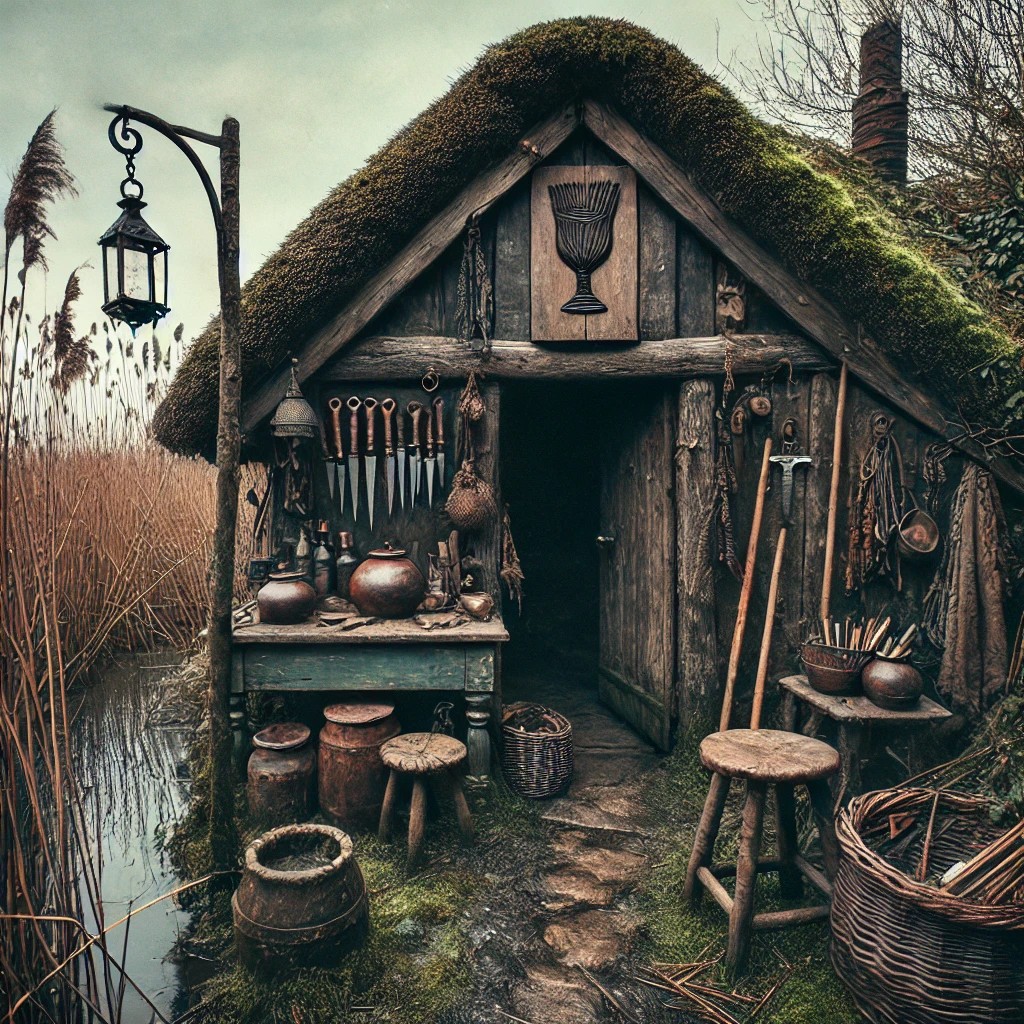
Inside, Caelan Reed stood behind the worn counter, his expression gentle yet guarded. “Lowen,” he greeted softly, recognition easing his careful gaze. “What brings you today?”
“Rosemary,” Lowen replied simply, watching Caelan’s expression closely. “Fresh, if possible. Dried otherwise.”
Caelan shook his head slowly, regret clear in his eyes. “None today, friend. Trade’s grown quiet, almost stilled. The House of Coin has tightened their grip—no goods in or out for now. Some dispute over broken agreements.”
Lowen sighed softly, disappointment flickering momentarily. They hesitated, choosing their words carefully. “There must be other ways. I’ve heard whispers of one—quieter track, unguarded.” They passed over some herbs they had carefully gathered for Caelan’s ailing father.
Caelan glanced at the herbs and regarded Lowen gratefully, eyes narrowing slightly. After a quiet moment, he leaned forward, voice low. “There is a path, rarely watched—once used by cautious traders and seekers of privacy. It leads eastward, past a landmark called the Cairn at Marshby Cross.”
Lowen nodded gently, absorbing each word carefully. “Is it safe?”
Caelan smiled faintly, rueful humor in his eyes. “Nothing is ever certain in the fens, but if anyone can navigate its quiet paths, it’s you. Be watchful, Lowen. Trust your instincts.”
Lowen thanked Caelan softly, slipping him a small bundle of herbs grown carefully for his ailing father. Caelan’s quiet gratitude warmed their heart as they stepped back onto the path, Myrtle snug in their pocket.
Facing east, they began their careful journey towards Marshby Cross and the coast, the promise of fresh rosemary guiding each determined step.
Chapter 7: The Cairn At Marshby Cross
Lowen found Marshby Cross just before dusk. They followed the narrow path through knee-high reeds, the ground soft underfoot. The mist drifted low across the waterlogged grass. And coming into focus — rising from the murk like a forgotten spine — was the cairn.
It was smaller than expected. A rough pile of stones nine foot high and six wide, some rocks weathered and sunken with age. And at the top of it, impossibly — rosemary.
Lowen, in dreamlike disbelief, found footholds and scaled the slope, boots sliding in the damp earth. The rosemary was in bloom, though it shouldn’t have been. The fens were too wet, the air too heavy. But here it was — flowering out of season, delicate and perfect.
Lowen hesitated. Their father’s hand was in this. That much they knew. Old Foss had been eccentric about herbs, known for planting things where they shouldn’t grow — but this? This felt deliberate.
Chapter 8: Smoke and Resin
Lowen worked in silence, the kind of deep stillness that wraps around you like a well-worn cloak. Mist curled and softened the edges of the world, but inside the small clearing near Marshby Cross, everything was sharp with intent. The clearing was sunken into the landscape, half-claimed by roots and ferns, a forgotten pocket of the world that now served as a workshop.
They laid out their tools carefully, each one with a purpose. The smallest of the three brass bowls—belonging once to Old Foss—caught the dull light and reflected it in soft gold arcs. Lowen settled it into their cooking pan, already warmed over a banked fire of embered moss and dry kindling from their pack. The pan had been scrubbed clean, inside and out. Their pestle and mortar sat nearby, the pestle worn smooth from years of use. The rosemary, picked fresh from the cairn, still carried the damp scent of morning and mystery.
They held one sprig up to the light. The bloom was too early for the season, impossibly so, its blue-violet petals vibrant against the muted world. Lowen crushed a portion gently in the mortar, the scent sharp and heady, then set three of the remaining flowers into a concave silver disc mould, an old casting dish lined in flat wire, shaped to form the centrepiece of a circlet.
The resin—a nugget of sticky pine gathered and traded in the summer—was warmed gently in a the brass bowl with the crushed rosemary, turning slowly viscous. Lowen stirred it with a clean stick, keeping the temperature low, not boiling, just persuading. When it reached the right consistency, they let the herb settle to the bottom, then carefully poured the resin over the flowers in the mould.
The mixture hissed softly as it settled. Lowen held their breath.
The resin cooled slowly, thickening around the blooms. The flowers, suspended in amber-gold, seemed to pulse with light. Lowen ran their fingers along the outer edge of the mould, checking for imperfections. None.
They set the finished disc into the silver circlet—an unadorned band, smooth and plain, save for the subtle twist of the wire that held the resin in place. No runes. No marks. Just the herb, the silver, the memory. The hum.
It wasn’t until the piece rested across their palms, complete, that Lowen truly understood what they had made. Not a charm. Not a product.
A bridge.
Something to offer Gwynviène—not as a gift, not even as a tool, but as a way to listen better.
They cleaned and packed their tools with care, wrapped the finished circlet in soft cloth, and began the quiet journey back. The mists followed, never far, as if curious.
Chapter 9 – What the Resin Holds
The light slants low when Lowen arrives at the door—less sun than haze, soft like river breath. The wind’s gone thin, scented faintly with dry bark and old petals. They pause, one hand raised, then knock twice against the carved frame.
A beat, then footsteps within. Gwynviène opens the door, her expression unreadable for a moment—then softer, like she’d been waiting without knowing it.
“You’re back from the coast, so soon?”
Lowen steps into the room as Gwyn steps back, no flourish, just presence. One hand rests lightly on the pouch at their side.
“I didn’t need to go that far,” Lowen says, the corner of their mouth tilting with something between wonder and disbelief. “There was a place on the old path, Marshby Cross… it felt like it had been waiting.”
They draw the wrapped bundle out slowly. It’s still swaddled in the clean cloth Lowen used to press it between layers of travel gear. The scent of resin slips out first—ambered, ancient, touched by rosemary’s sharp bloom. Gwynviène’s gaze falls to Lowen’s hands, following every turn of the cloth.
Inside is the circlet.
A thin chain of silver set with a single round disc of golden pine resin, warm and translucent as honeycomb. Caught inside, suspended perfectly, are several rosmarinus flowers—blooming out of season, unspoiled.
Gwynviène lifts it carefully by the silver band. “You… made this?”
“I did.” Lowen swallows. “The flowers were out. Out of time, out of place. Something about it was meant.”
Gwynviène places it slowly against her forehead, the resin resting just between her brows, the chain slipping back into her hair like it belongs there. A stillness follows, deep and strange.
Then her breath catches.
A flicker behind her lavender eyes, something shifting—sorrow or awe or recognition. She stumbles back a half-step, clutching the circlet as if to steady herself.
“I saw—” Her voice breaks. “Not a place. Not yet. A feeling. Like something trying to remember me. Like it was reaching.”
She draws a hand to her temple, gently pressing where the resin lay. “It’s stronger than before. The memory isn’t just mine now.”
Lowen lets out the breath they’d held. “I wasn’t sure if it would work. Not like that.”
“It’s not a charm,” Gwynviène says, almost dazed. “It’s a key.”
They sit together in silence after that. Myrtle surfaces from Lowen’s pocket, circles their ankles, then rests her small frame against Gwynviène’s heel without ceremony. Outside, somewhere unseen, a lark tries a song and thinks better of it.
Gwynviène removes the circlet and sets it gently in her lap.
“Whatever happened at Marshby Cross,” she says softly, “it’s waiting. There’s more in that place. Someone put the rosemary there to remember.”
Lowen nods, the memory of Old Foss a silent drumbeat behind the words.
“I want to go,” Gwynviène says. “Not just to feel it again—but to listen properly. With you.”
Lowen looks down at their fingers, rough from crafting, stained faintly with resin. “We’ll go.”
They don’t say when.
The circlet glows faintly in the dimming light.
Chapter 10 – Return to Marshby Cross
The night before they left, Gwynviène laid out her notes on the narrow writing shelf beneath her window. Pages copied in her own neat hand, rubbings of runes from the oldest tomes, and a single sketch of the cairn that she’d drawn in the quiet hour between candlemarks. She did not need to bring them all. This journey was not only research. There was something else calling her back—quiet, insistent. Not a summons, but an ache.
Lowen packed methodically by lanternlight. Their satchel held strips of linen, bundles of wrapped herbs, the smallest brass bowl from the stack, and the flask of resin that had already begun to darken with time. They tucked two extra lengths of silver wire into a pouch alongside a curved file and polishing cloth. Myrtle scurried along the edge of the cart, sniffing the wooden slats as if searching for something left behind.
“Always acts like she knows where we’re headed,” Lowen murmured, tightening a leather strap. “I just follow the cart.”
The morning mist rolled in before the sun. By the time they reached the edge of the last known track, it lay thick and low across the fens, pressed close to the ground like breath that couldn’t rise. The path narrowed between alder thickets, their branches heavy with damp. Neither Lowen nor Gwynviène spoke much. The world was quieting around them.
They stopped only once, when the light shifted and a sudden stillness overtook the marsh. Gwynviène adjusted the circlet on her brow. Her eyes unfocused for a breath, then sharpened. “Here,” she said quietly. “Something was said here. Long ago.”
As they moved further into the lowland, the mists seemed to pull sideways instead of rising—forming avenues, not veils. Occasionally, a shape would suggest itself in the fog: the vague outline of a gate long gone, a figure walking with purpose, a scattering of petals across stone. The visions came in pieces, flickering at the edge of awareness, half-felt, half-seen.
Then the cairn emerged. Pale stone layered with time and lichen, its form softened by seasons. But the rosemary still bloomed. Soft green needles and out-of-season flowers, vivid against the muted tones of the fen. The scent was bright, unbothered. It clung to the still air like an old song.
Gwynviène stepped forward and paused.
Lowen held out a hand instinctively. “Wait—”
Gwynviène’s breath caught. She staggered a step and then stilled, her gaze gone somewhere far past the present.
Lowen remained close, not touching but near enough to anchor.
What Gwynviène saw unfolded slowly: a firelit gathering. Fae, noble in bearing but quiet in manner. One stood apart, holding something glinting—perhaps a coin, perhaps something sharper. Another turned away. Someone whispered words that should have mattered but were left unspoken. The Gilding, not as legend, but as wound.
And in the background: rosemary, freshly planted. A man’s hand pressing it into the soil—not during the memory’s making, but long after. The earth still hummed faintly with what had happened there, and he had felt it. His voice didn’t speak, but pulsed through the air like the rhythm of grief and resolve. Old Foss—not young, but with some colour in his hair still. He was not witnessing the wound, only its echo. And in marking the place, he asked it to be remembered.
The air snapped. Gwynviène gasped. The memory blurred, drained out of the present like water receding.
Lowen caught her arm gently. “You’re here,” they said, voice low and solid. They pulled a small bundle from their satchel—a nosegay bound in linen and twine. “Breathe.”
Gwynviène took it with trembling hands. The scent was soft and familiar: chamomile and crushed marjoram, a thread of meadowsweet, a whisper of dried mint. Not for memory, but for the now.
She inhaled once, twice. The noise in her mind quieted. Her shoulders eased. Her eyes refocused.
“They tried to bind it here,” she said after a long moment. “A memory. Or… a decision.”
Lowen nodded, paused. “Or they tried to forget.”
The wind stirred. Even the birdsong felt careful.
They sat side by side on the stones for a while, not speaking. Myrtle burrowed into the crook of Lowen’s arm and blinked at the sky.
When they finally rose, Gwynviène touched the circlet with reverence. “We don’t tell anyone. Not yet.”
Lowen simply nodded.
Some truths weren’t secrets. They were seeds. Waiting for the right place, the right moment.
And the right hands to plant them.