Main:
Gwynviène Avenloré
Other:
Aurenne “Ren” Avenloré, Lady Syraëlle Avenloré, Lord Caladien Avenloré, Panvier, Éliane, Tharanne, Nicéon, Sylvérian Avenloré, Aestrelle Avenloré, Lord Theridian Avenloré, Lady Virella Avenloré, Lady Celarienne Avenloré, Lady Lineia Avenloré, Lord Tavian Avenloré, unnamed staff and townspeople
Where:
The Palace of Vaevessaire and its surrounding town and forest
When:
Present-day Evergild Era; early summer
Theme:
Illusion and awakening, privilege, memory, beauty, hidden histories, transformation, disquiet
Summary:
Invited to spend the month of summer festivities at the Palace of Vaevessaire, Gwynviène Avenloré arrives giddy with joy — swept into a world of silk gowns, floating lanterns, and the fairytale glamour she’s always adored. But beneath the shine, something shifts. A servant flinches. A ruin hums with memory. A ride through the forest brings echoes of stories untold. As the weeks pass, Gwyn begins to see past the golden veneer — not abandoning her joy, but letting awareness settle beside it. The Palace is still beautiful. But now, she sees the cracks beneath the gilding — and begins to wonder what was lost to make it gleam.
Part I: The Horizon
The first glimpse of Vaevessaire never failed to take her breath away.
Gwynviène Avenloré leaned out the carriage window, the wind teasing loose strands of her hair, and smiled as the palace appeared over the crest of the hill — a vision of light and symmetry rising out of the green. Gold-tipped roofs caught the sun, casting ribbons of radiance across the landscape. Below, the town shimmered like a jewel box unfurled: tree-lined avenues, pale-stoned façades, gardens carved into perfection.
Her heart fluttered like a ribbon in wind.
“We’re nearly there,” she said, not to anyone in particular.
As the carriage rolled into the outskirts of the town, Gwyn leaned further out the open carriage window, eyes wide with delight, fingers curled over the edge of the doorframe. She waved at a pair of young girls carrying flower baskets along the road, who waved back with shy grins. A baker, brushing flour from his apron, tipped his hat. A musician on the corner plucked a bright tune on his lute, and Gwyn swore he winked at her as they passed.
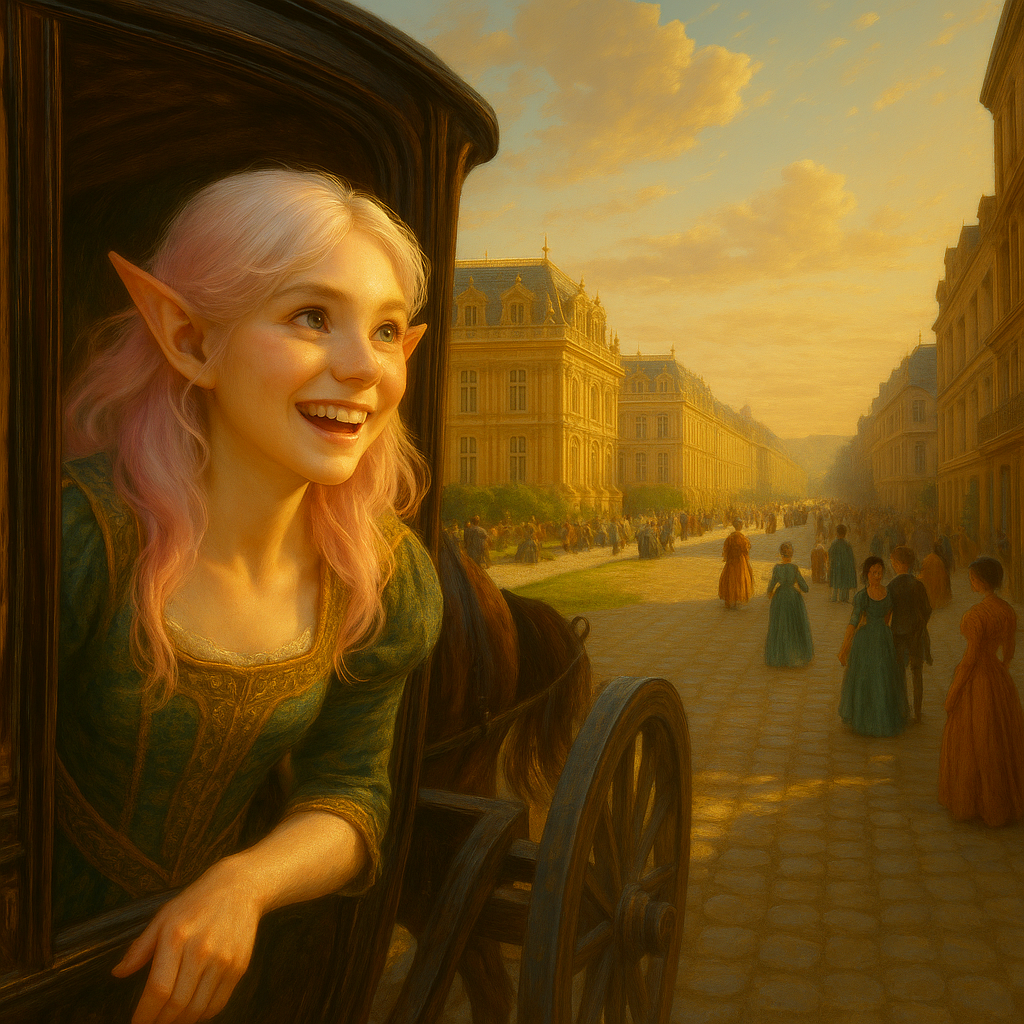
She laughed — not a quiet, courtly laugh, but a real one, full of the joy that rose in her chest like a fountain.
Across from her, Ren was half-asleep with their boots kicked up on the seat, a book propped against their knees and their head resting on Panvier‘s soft, furry flank. Their nonchalance made Gwyn smile. She didn’t know how anyone could sleep through such a moment. Even their parents were quiet now — Lady Syraëlle glancing up from a scroll, Lord Caladien thoughtfully tracing the rim of a travel cup.
“Do you remember,” Gwyn said, “the garden lanterns that float on midsummer night? Like fireflies, but spun from silk?”
“You say that every year,” Ren murmured without opening their eyes.
“Because it’s worth remembering every year,” Gwyn replied, and she didn’t care if it made her sound giddy. She was giddy.
This was the first year she’d been invited to stay for the full month of festivities — no curfews, no early returns to the Library, no watchful aunt reminding her to act her age. She had a wardrobe full of gowns, a notebook of sketches for potential hairstyles, and three distant cousins she couldn’t wait to see again — Éliane with her sky-laughter, Tharanne who played the glass harp like it was spun water, and sweet Nicéon who always sneaked extra pastries into her pockets when no one was looking.
The Palace of Vaevessaire was summer turned architecture. A place of chandeliers and violin strings, of laughter in gardens and secrets shared behind fans. It was the life she had always dreamed about — a fairytale in living colour, gilded and perfumed.
The carriage wheels creaked as they turned onto the main avenue. Statues lined the road like sentinels, each one older than memory. Gwyn sat straighter, tugging her gloves into place. Her reflection caught in the window — eyes bright, cheeks flushed, anticipation written into every feature.
She had always felt most herself here. In the music, the motion, the colour. In the feeling that she was part of something grand, something worthy of poetry.
She did not yet know that this was the visit where that feeling would begin to shift.
Not disappear — not yet.
But soften. Tilt. Refract.
For now, the gates opened. And Gwynviène Avenloré stepped out into the golden light of the Palace of Vaevessaire with her heart open wide, ready to dance.
Part II: The Gilded Nights
The first night passed in a whirl of music and light. The great hall was awash with colour — gowns that shimmered like riverlight, lanterns strung from tree to terrace, and music that seemed to hang in the air long after it ended. Gwyn danced with abandon, her dress the colour of dawn flaring with every spin — soft rose, peach, and gold hues catching candlelight like a sunrise. She twirled across the polished floor, cheeks flushed, laughter spilling like stardust. Her parents were off somewhere discussing scholarly politics and catching up with old acquaintances. Ren — well, no one ever quite knew what Ren got up to, which Gwyn had always admired. Her brother Sylvérian stood tall at the edge of the dance floor, deep in conversation with a fellow scholar. Somewhere, no doubt, her cousin Mirelyn was shadowing his father, Lord Theridian, the current head of House technically the host of all of this. Aestrelle, Theridian’s daughter, was in her element — the princess of the ball, radiant and unbothered. Aunt Virella looked sour-faced as ever near the conservatory entrance. Ilién, Gwyn’s dearest cousin, had stayed at home this year, along with her mother, Lady Celarienne. Uncle Tavian and Aunt Lineia rarely ever attended.
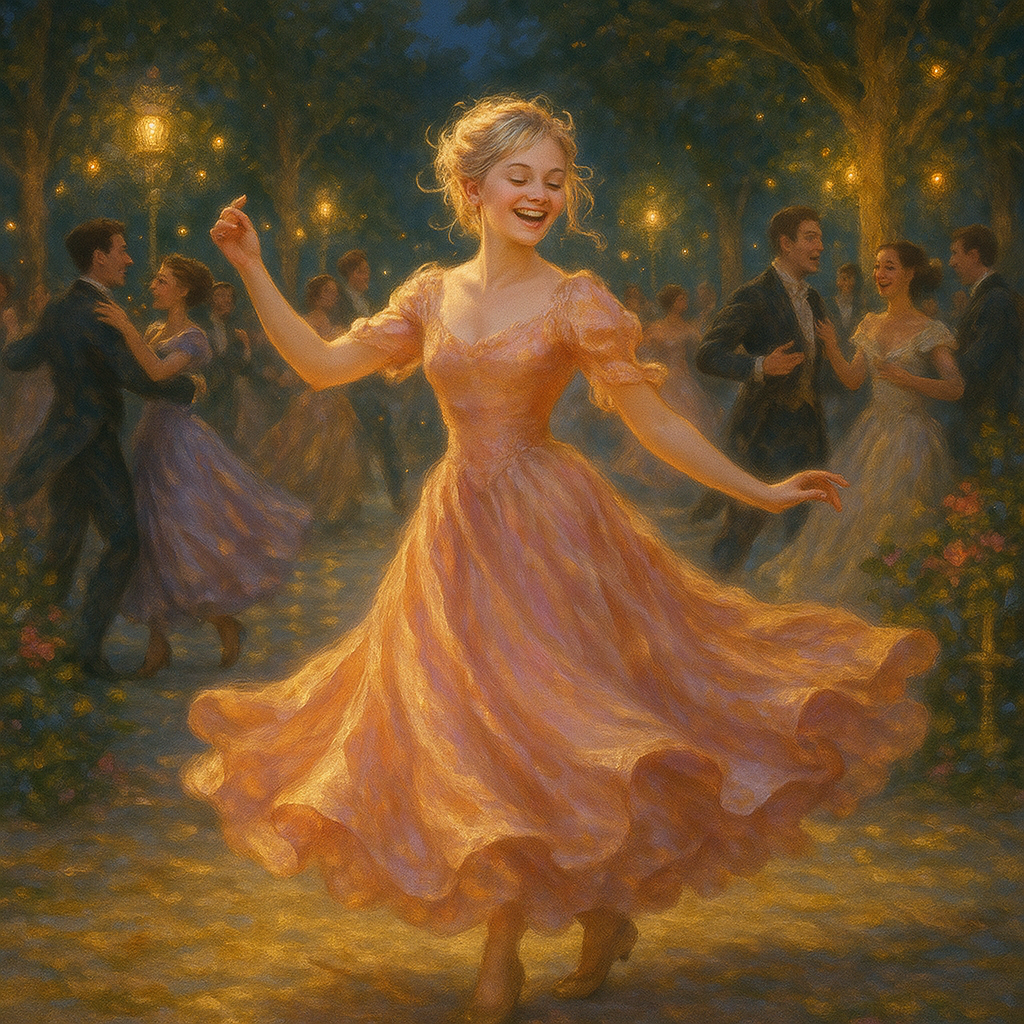
The second night was more of the same — a thousand candles lit the garden walkways, music floated from unseen sources, and the scent of honey and herb hung in the air. Gwyn lost track of time in a blur of compliments, storytelling, and sweet-tart drinks served in crystal flutes.
She adored the softness and quiet rhythm of home — the comforting hush of the Library’s corridors, the slow bloom of a candlelit evening, the rustle of pages turning in her parents’ study — but here, at Vaevessaire, she sparkled. This was her stage, her storybook come alive.
As a child, she’d been told tales of its past: how the palace had grown from a humble cottage into a sanctuary of wisdom and wonder. A refuge for scholars and nobility alike. They spoke of it as a place where magic and grace walked hand-in-hand, where lanterns always glowed and the trees bowed in welcome. No one had ever spoken of hardship. No one had spoken of those who had once lived in the village and were no longer seen.
But on the third night, something caught.
She was halfway down the eastern staircase when it happened. Her cousin Éliane was already at the bottom, flushed with excitement, waving her down — something about a magician from the coast who had arrived that evening with a phoenix-feather cloak and tricks that made fire dance on water. A footman offered his arm to Gwyn as she descended, and as she passed, she heard a sharp voice — one of the visiting lords — snap at a maid for dropping a velvet shawl.
The maid bent to pick it up. And flinched.
Just for a second. But Gwyn saw it.
She hesitated on the step. Her gaze shifted back to the footman still waiting beside her, polite and still — and she realised, suddenly, there was always a footman on hand. Always someone waiting. Always someone watching. The music floated up from the ballroom below, gilded and sweet. But her joy had started to dulled.
Later that night, when a string of floating lanterns bloomed overhead — her favourite part — she didn’t feel that same rush of wonder. Just a faint ache.
She didn’t understand it yet. But the rhythm had shifted.
Part III: The Ride
The next morning, Ren and Gwyn borrowed a couple of horses for a quiet ride along the misty borders of the estate. Panvier bounded ahead in the dew-soaked grass, tongue lolling, tail high and jubilant. On most mornings like this, Gwyn would’ve galloped beside him, shrieking with laughter as she urged her horse faster, racing sunbeams and leaving Ren to catch up. She’d chatter endlessly too — recounting every delight of the night before, from the best-dressed guest to the juiciest snippet overheard behind a fan.
But today, her hands rested loosely on the reins, and her gaze wandered without purpose. She rode in thoughtful silence, the morning’s hush settling around her like a veil. Ren, noticing the shift, didn’t comment right away. They simply rode beside her, letting the quiet stretch long enough to be gentle, not awkward.
“You’re usually the one trying to get Pan to fly,” they said after a moment.
Gwyn smiled faintly. “I suppose I’m letting him take the lead today.”
The air was soft with mist, and the forest edge shimmered with birdsong.
They followed an old path, one Ren had heard about from a stable hand. “Leads to a half-ruined cottage,” they said. “Probably full of spiders. You’ll love it.”
But when they arrived, Gwyn felt something strange.
The cottage wasn’t grand — just crumbled stone, a hearth swallowed by ivy. Once, she would’ve imagined lovers there. A place of secret meetings, whispered vows, maybe a hidden child with stars in her blood. Gwyn had always been good at those stories.
Now, though — something tugged at her.
Not a story. A sensation.
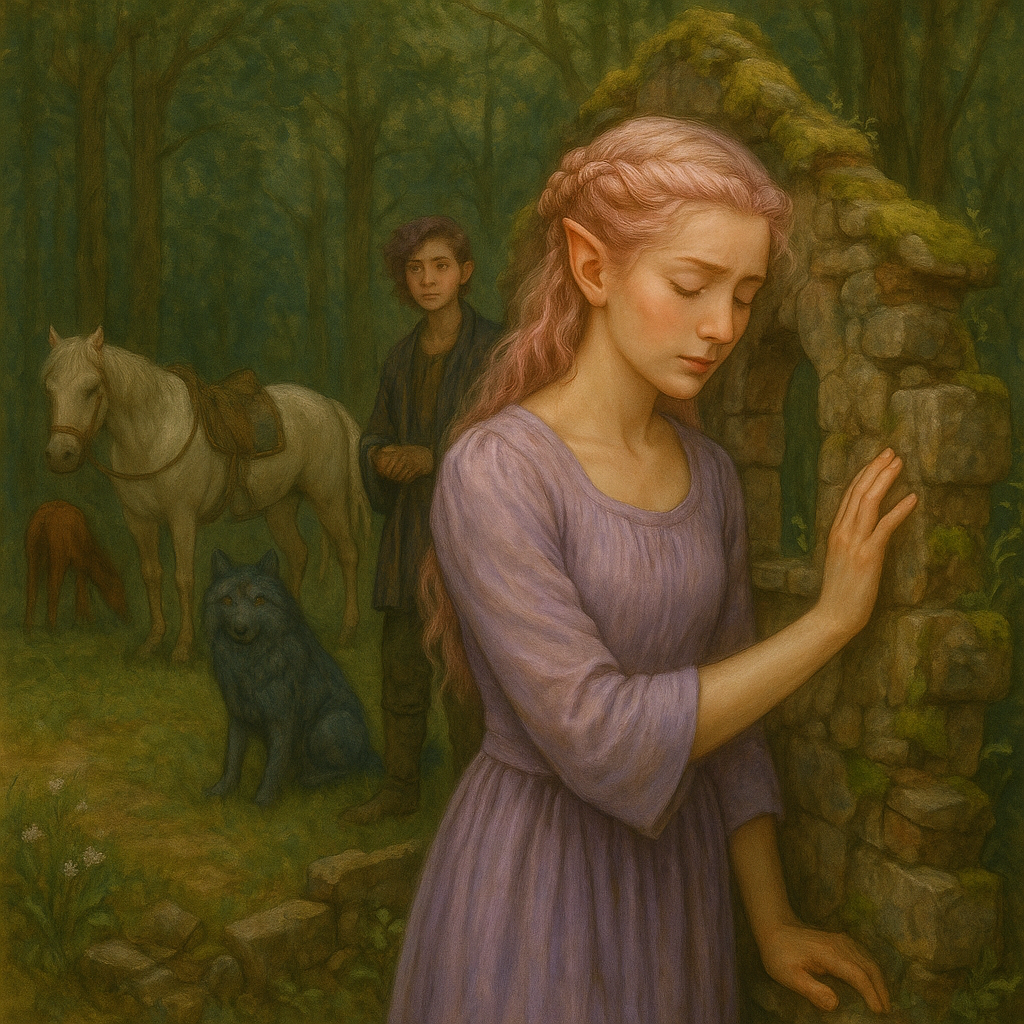
Sadness. Strain. A heavy, familiar ache in her chest, as if the very soil remembered who had once been forced to leave. Her magic hummed, not with curiosity, but with a warning. She placed a hand on the stones. Closed her eyes.
She saw a pot left too long on the fire. A child’s shoes worn through at the heel. A garden abandoned in the middle of harvest.
Not a romantic ruin. A home lost.
She didn’t speak for a while. Ren threw stones into a hollow tree and didn’t press her.
When she opened her eyes, she looked out at the forest. “I think someone lived here, Ren. This isn’t just the ruins of an abandoned cottage, it was someone’s life.”
Ren took a step closer to her, “You’re shaking.”
“It’s… taking more than I thought. The magic. The knowing. It’s not just echoes — it’s weight.”
Ren nodded once, watching her closely. For a long moment, they didn’t say anything, just studied her face — the tension in her brow, the way her hands trembled slightly. The silence stretched between them, not heavy, but searching.
Finally, they reached out and gently took the reins from her fingers. “You’re pale,” they murmured, grounding her in the moment with the quiet steadiness that only Ren possessed. “Let’s get you back.”
Gwyn didn’t argue. The ruin still tugged at her thoughts, lingering like smoke.
They turned their horses slowly. The forest whispered behind them.
Then, after a beat, Ren added with a slight smile, “Besides, I heard they’re serving those little cakes you like — the ones with the rose sugar.”
Gwyn managed a laugh, but her gaze lingered on the ruin.
Later, as she sat before a table of rose-sugar cakes — just a little too sweet, the sunlight just a little too bright, the chatter around her a little too loud — Gwyn found herself picking at the edge of a napkin, the sweetness clinging to her tongue longer than it should. The table was crowded, voices rising in a dozen directions, but she felt oddly alone within the noise. Her head ached faintly from the sunlight, and her eyes drifted across the terrace — to the sculpted hedges, the shining trays, the ever-smiling servers moving like shadows.
She thought of Low.
Of their quiet insight, the way they noticed the stories others stepped over, the questions they asked without words. She wished she could speak to them now — not to explain, but to ask, simply: Do you feel it too?
Part IV: The Quiet Turn
It had been a couple of weeks since that first carriage ride down the gilded road.
Gwyn had danced. Had laughed. Had twirled beneath star-silvered arches and sipped sweet wine in garden alcoves with cousins and friends. She had whispered secrets between bursts of music, had spun through rose-scented courtyards, and collapsed into laughter on silk cushions while counting stars. The stories she had dreamed of living had briefly seemed real. Even now, she still wore some of that magic like perfume clinging to silk.
But something had changed.
It had crept in quietly — not in the grand, sparkling moments, but in the spaces between.
She noticed more.
The servant who smiled too quickly. The elderly man who swept petals off the back terrace before sunrise. The gardener who paused at the edge of the great lawn, looking toward the trees as though listening for something. The way someone flinched when spoken to too sharply, the way the shadows behind the lights seemed a little longer now.
She still let herself enjoy it — the silk, the stories, the shimmer. But the joy had become more complicated. A beautiful painting, now seen with the knowledge of the cracks beneath the gilding. She tucked that thought into her pocket like a pressed flower — something delicate, worth keeping, but no longer alive in the same way.
On the last night, someone called the palace “the Cottage,” and Gwyn laughed with them. But her laugh was quieter now. Not mocking. Not quite wistful. Just… knowing.
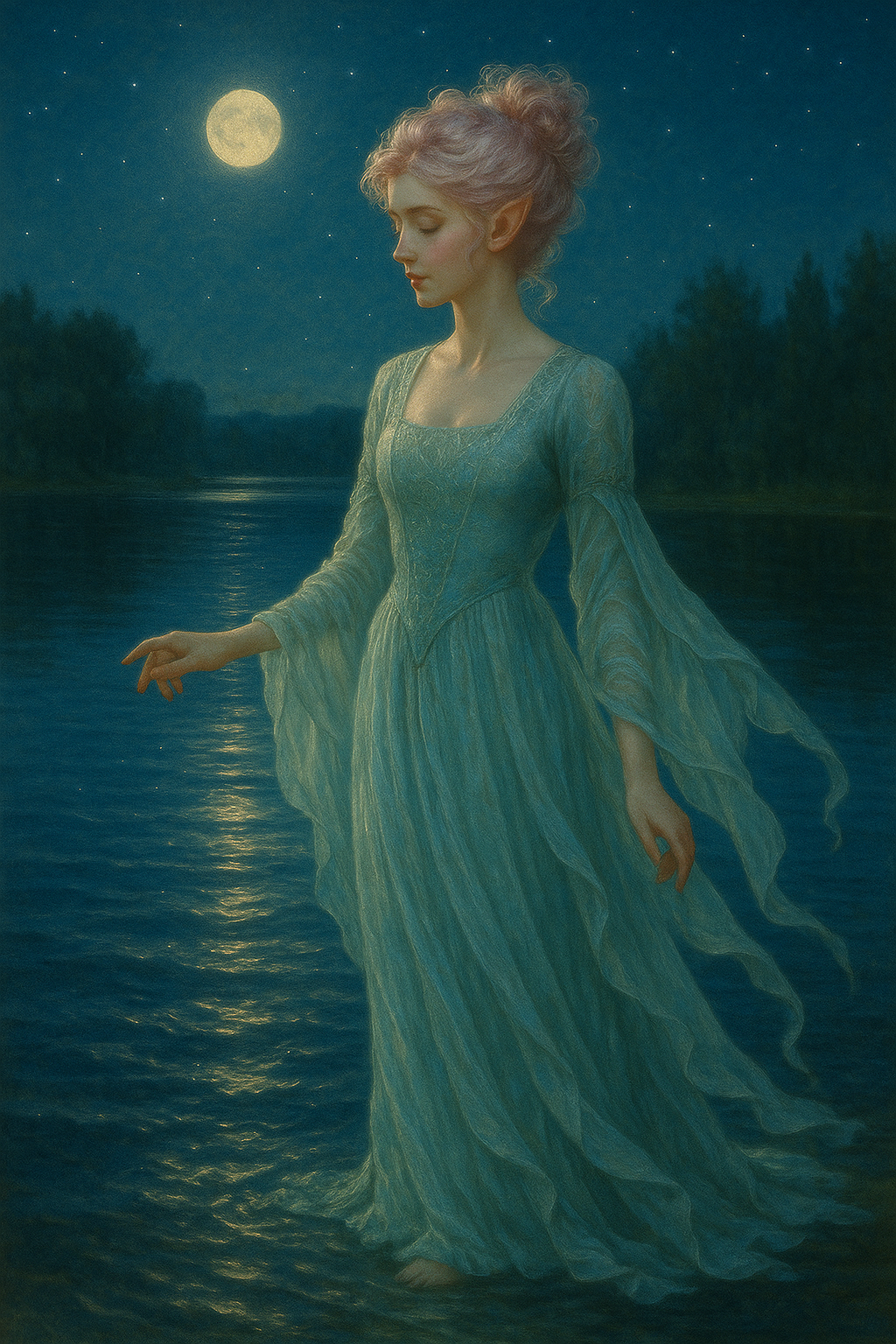
Afterwards, she slipped away from the music and the wine. The lanterns still floated, soft as dreams, but they no longer held the same wonder. Her feet took her down to the edge of the lake, away from the polished stone and toward the reeds. Her gown trailed dew behind her.
The moon hung heavy, reflected in the glassy water, but when Gwyn looked into it, she didn’t see herself. Not really.
She saw the trees.
And they were waiting.
Waiting for her to see what she had been trained not to.
Waiting for her to remember that even in a world gilded with beauty, not all things bloom without cost.