Main:
Lady Syraëlle Avenloré, Lord Caladien Avenloré
Other:
Lady Velarienne Avenloré, Lord Thamior Avenloré, Caladien’s brother, unnamed cousin from House of Steel, Sylvérian Avenloré, Gwynviène Avenloré, Aurenne “Ren” Avenloré
Where:
The Library, Astravayne, various diplomatic summits and gardens
When:
Several decades before the present day; the early adulthood of Syraëlle and Caladien
Theme:
Love vs duty, inter-House conflict, legacy, intellectual intimacy, choosing gentleness, reshaping tradition
Summary:
Amid the political tension between the House of Scholars and the House of Spires, Syraëlle Avenloré and Caladien Illistar find an unexpected kinship that blossoms into a deep, defiant love. Their relationship is tested by tradition, expectation, and family disapproval — but it endures. Though Syraëlle never ascends as Head of House, she reimagines the Archivum into a living space of shared learning. Caladien leaves behind the rigidity of the Spires, choosing a quieter path with Syraëlle and their children. Together, they build a home where knowledge and kindness hold equal weight — and where love, not lineage, leads the way.
In the pale halls of the Sanctum Arcanum, where starlight filtered through high, hex-glassed windows and the scent of spell-ink clung to every surface, Caladien Illistar of the House of Spires, his dusky lilac skin and silver-touched hair reflecting his heritage, stood with his hands behind his back, barely listening to the incantation being recited. The Starborn gathered for a rare convergence, but his thoughts were elsewhere. He had recently returned from a diplomatic summit at The Library, the seat of the House of Scholars—and something in him had not settled since.
She had not been what he expected.
Syraëlle Avenloré was not like the other scholars—she did not speak in footnotes or debate for the pleasure of winning. Her voice had the lilt of a question always forming, her mind agile and wide as the skies above Astravayne. He had gone to The Library prepared to argue against their reckless proposal to unseal the Moonbound Tomes. He had not expected her to agree with him. Nor had he expected her to walk with him afterwards through the eastern gardens, her soft fingers trailing the tips of the rosemary hedges as she asked why he truly feared the tomes.
“Because some knowledge forgets how to sleep,” he had said.
She had smiled at that, not with mockery but with quiet admiration.
For years, the House of Spires and the House of Scholars had existed in a careful tension. The Spires saw themselves as the guardians of arcane law and celestial balance, holding tightly to the reins of magical practice. To them, the Scholars were meddlesome and undisciplined, obsessed with theoretical relics and half-truths pulled from forgotten scrolls. The Scholars, in turn, believed the Spires wielded magic as a blunt instrument—hoarding access, silencing curiosity, and turning living knowledge into cold bureaucracy.
Syraëlle had already been marked for greatness, though not in the way her mother wished. Whispers were that she was to inherit the Archivum—a wing of The Library devoted to historical record and long-term preservation. Among the House of Scholars, the Archivum was seen as a quiet cul-de-sac, useful but lacking prestige. Lady Velarienne Avenloré, the formidable matriarch and Head of the House, had hoped her daughter might one day succeed her entirely, not simply inherit the shadows of the past. She had even begun quiet arrangements for Syraëlle to be courted by her second cousin, a promising warrior from the House of Steel—disciplined, dutiful, and well-respected within his own ranks. The match would have symbolised strength and stability, uniting the Scholars’ lore with the martial honour of Steel, and ensured that the Avenloré line remained anchored in traditional alliances. Just like her own had done with Syraëlle’s father, Lord Thamior Avenloré.
But Syraëlle’s fascination with history was unwavering—and her insistence on courting a son of the Spires only sealed her fate.
Their courtship was not swift, nor simple. The Spires distrusted the Scholars, and the Scholars, in turn, regarded the Spires as joyless wardens. At every gathering, they were watched—a scholar and a regulator, whispering across the divide. Rumours circulated. Caladien was forbidden from entering The Library without escort; Syraëlle was removed from two diplomatic committees for “conflicted loyalties.”
But in quiet corners of archives, and beneath candelabras at diplomatic feasts, they found each other again and again.
He enchanted her quills to never run dry. She gifted him a historian’s map that charted not borders, but forgotten ruins and fallen stars.
They argued, often. About the ethics of enchantment. About whose histories mattered. About the very role of magic.
And yet, they returned.
Lady Velarienne did not speak to Syraëlle for three full seasons after her intentions became clear. Syraëlle bore it with dignity—though her journals from the time reveal tear-stained pages, and ink blotted where she paused too long. Caladien, too, faced resistance. His elder brother accused him of betraying the purity of their purpose, of placing sentiment above structure.
Still, they held to each other.
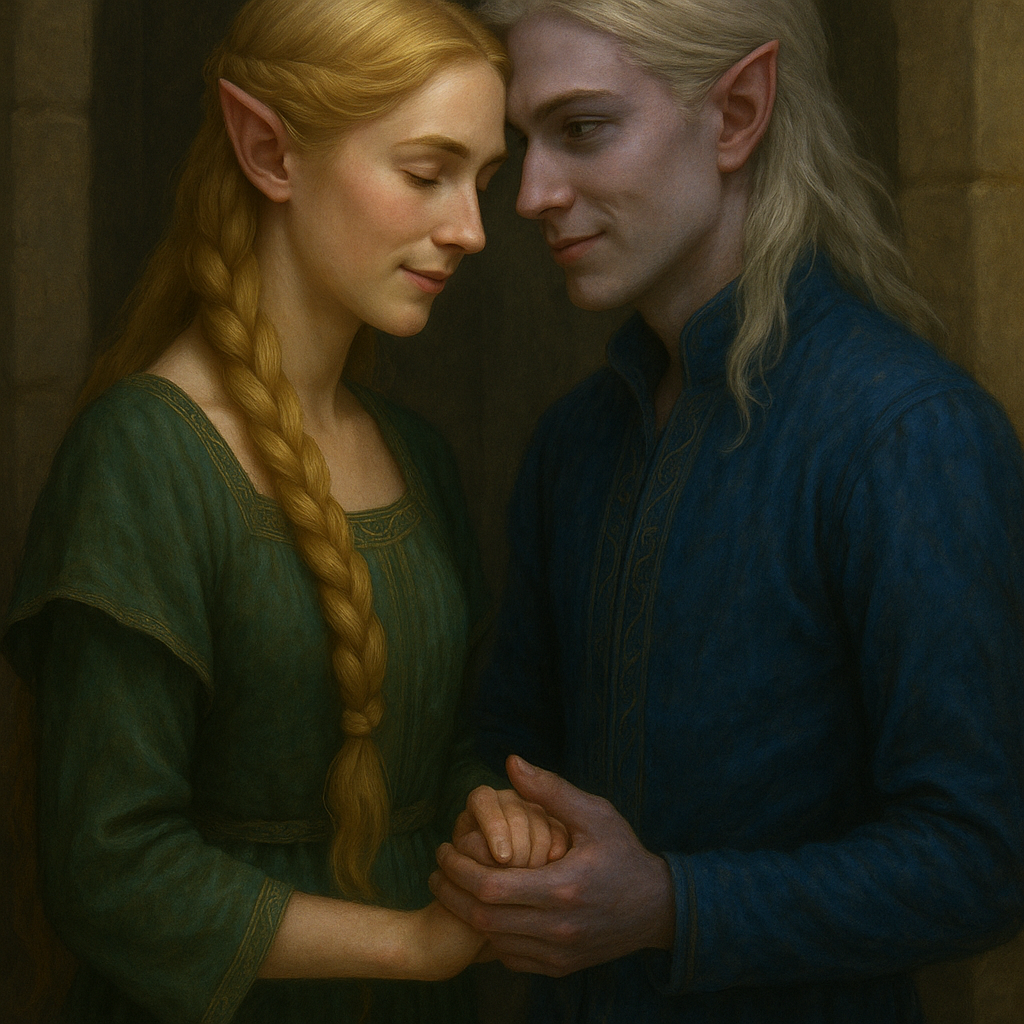
Once, in a stolen moment between summits, Syraëlle pressed her hand to Caladien’s chest and whispered, “If I must choose between being my mother’s heir or being yours, I choose the life we could make.”
“Even if it costs you everything?” he asked.
“What use is everything, if not shared?”
Years later, after the binding oaths had been made and Caladien had taken the name Avenloré to stand beside her, some still whispered. Syraëlle had never risen to lead the House of Scholars. But under her stewardship, the Archivum became more than a dusty wing. She opened it to visiting minds, let students and silversmiths and even spellwrights walk among its scrolls. She carved a legacy not from power, but from preservation.
The family they created, their children, Sylvérian, Gwynviène and Ren would grow up in a home where law and lore danced together. Caladien, once raised in the rigid shadows of arcane law, found unexpected joy in the messiness of family. Within the walls of the Archivum, amid books and laughter, he learned that love could be quiet and steady, not bound by contract or duty. And in Syraëlle’s warmth, he let go of the perfection expected by his kin.
He taught their children the constellations, Syraëlle taught them stories—and both taught them that power need not always shine.
In a society where the Evergild were taught to bear their brilliant, otherworldly skin as a mark of strength, Caladien showed his children that muted tones were not shameful, but sacred. He did not always shimmer with lilac and starlight—instead, he sometimes let his magic rest, his skin softening to more mortal hues. And in doing so, he taught them that choice was its own magic.
And it began not with an alliance of Houses, but a quiet walk beside a rosemary hedge—and a question neither of them could answer alone.