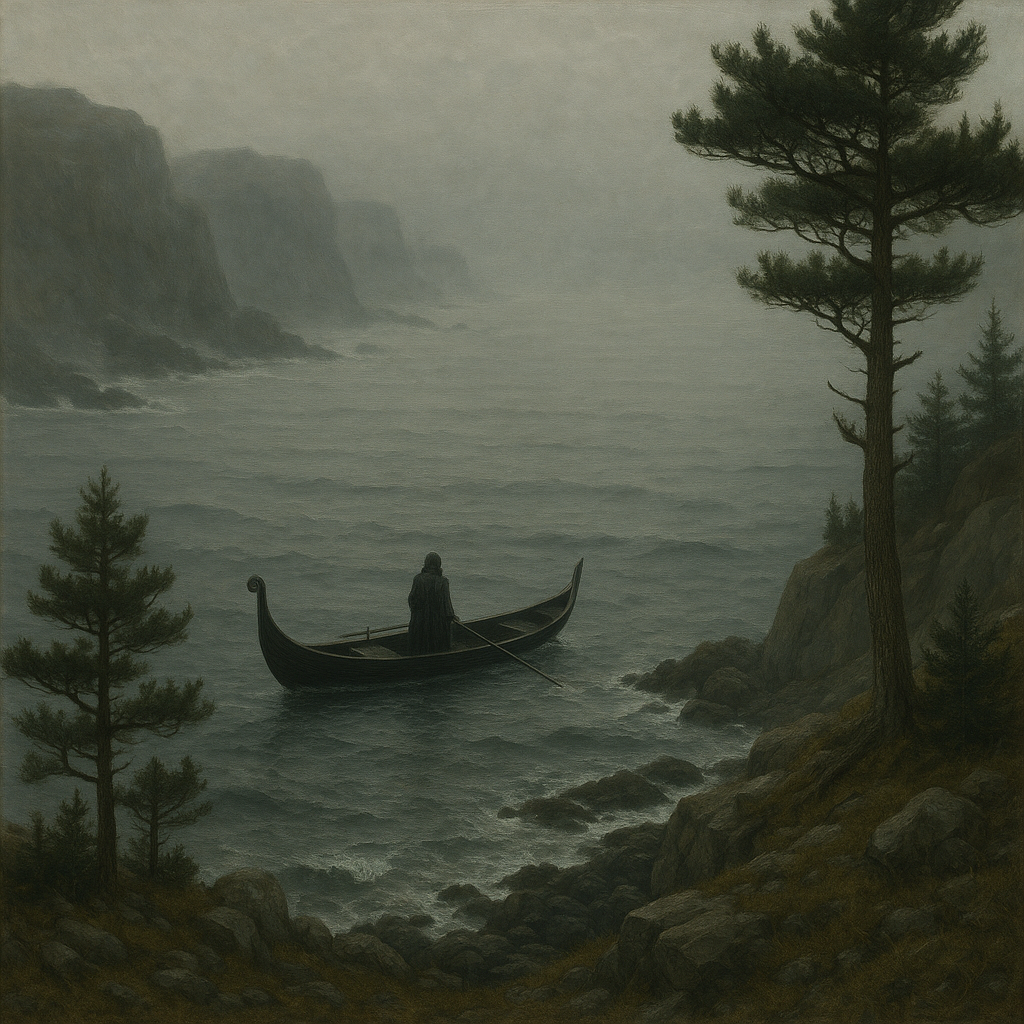
Skarn ul’Vaeth arrives on the island of Farra by boat, long and low with silverwood oars and bells that chimed in the fog. He brings fine silver thread as trade and says he wishes to place an order — a bolt of embroidered cloth for a collector from beyond the Spires. He offers quiet respect for the island’s customs and asks only to observe. He watches the weavers, stands at the back of festivals, learning chants. Never pushes.
Each dusk he finds a spot alone on the shore and performs private rituals — geometric symbols in the sand, hands raised to constellations — just within sightline.
Cirra was young and bright-eyed, drawn to wonder, to anyone who stepped outside the expected pattern. She watched Skarn’s rituals; he never acknowledged her. That only drew her in further. His stories dripped out slowly — a vision of magic unshackled by rules, of a new resonance, freer and purer. She fell in love with the story. And was in awe of the man, or what she thought him to be.
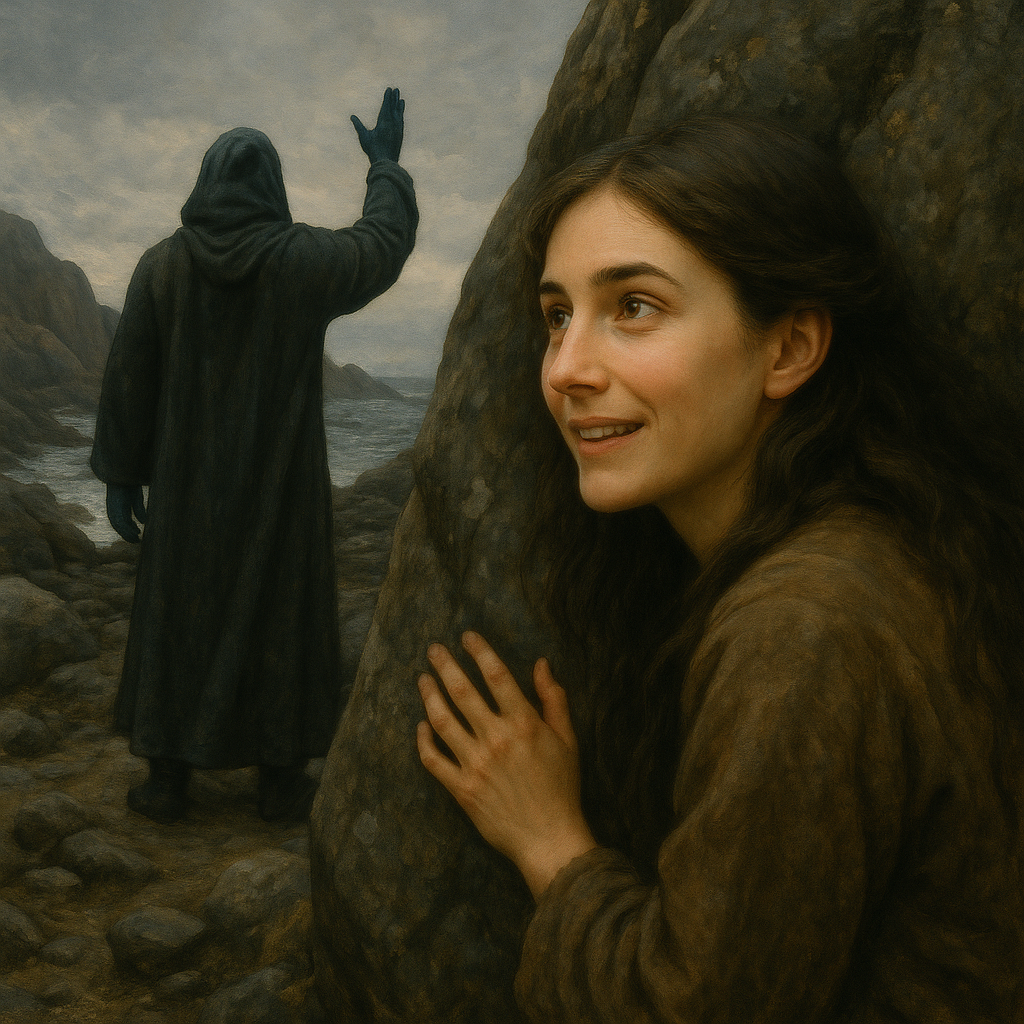
She already had a partner then — a weaver’s apprentice, kind-eyed, a little restless, eager to believe in more than the island’s stone-set ways. When she told him she was pregnant, he wept with joy. Skarn was already gone by then, vanished under fog as quietly as he had arrived. But not before the ritual.
In secret, Cirra and Skarn — more the latter — had performed a harnessing ceremony. A forbidden rite used to bind the domain of one being’s power — what their magic touches or commands — directly into another, so that the force they once shaped becomes the other’s to wield.
Skarn called it an inheritance, a way to ensure the child would not just carry potential, but purpose. Cirra, caught in his vision, believed it a blessing — a birthright made certain.
In her case, the ritual bound her elemental affinity — wind, rain, storm — into the unborn child, not as legacy, but as a conduit made permanent.
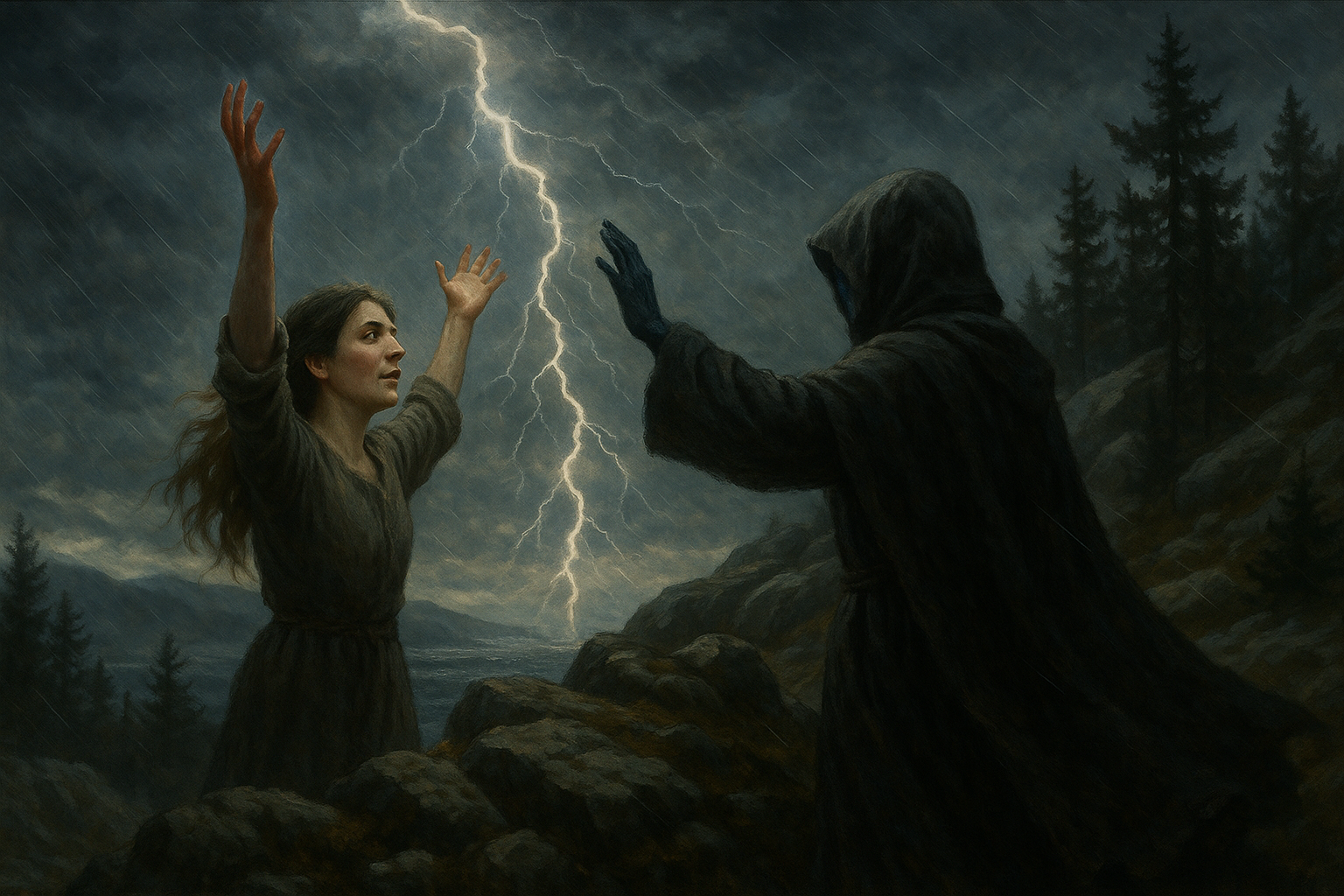
To the boyfriend, the ceremony was just an old blessing. A charm for magical strength. Cirra believed that too — or told herself she did.
The baby was born, a son. Cirra died in childbirth.
Her family were distraught, and none more than her sister Stellan. It came out as anger. She spent long hours at the high crags overlooking the sea, lightning in her eyes. She yelled into the wind. At first, she spoke to the boyfriend with a firm, controlled voice:
“This child needs a mother. I will stand in place of my sister.”
But she was kept at arm’s length. The boy’s father (or so he believed) was grief-struck, protective, and quietly suspicious of Stellan’s intentions — and her gift. The child startled at nothing, stirred breezes with his cries, shivered when the sky turned. And Stellan, with her sharp eyes and seer’s quiet, felt too close to the root of it.
His parents and kin helped raise the child. They kept their grief neat, their days busy. Stellan brought sheep’s milk, washed his clothes. She watched.
She longed to swaddle the baby in their family’s cloth, to anoint him with spring water and chamomile, as was their custom. But it was never quite her place.
His name was Kallhor. Cirra had chosen it before the birth — after the hidden river said to run beneath Farra’s stone, unseen but constant, the island’s oldest secret. The river carried stories of escape, of quiet survival, of paths no one could follow. To name him for it was to speak both hope and warning. Kallhor meant flow within rock, the current that could not be bound. Stellan never spoke it aloud once Cirra was gone. She used it only in ritual, and later, only in writing. To the rest of the world, he was simply Kell.
He startled easily. Sounds overwhelmed him. He did not speak. His gift, if it could be called that, was quiet but eerie — flurries in still air, rain without clouds, a subtle shift in pressure before sleep. Stellan watched these moments with unease. The others didn’t notice. Or didn’t want to.
Then Skarn returned.
Again, he came under pretence of trade — fine cloth, sea-stone buttons, orders for linen. Nothing unusual. But Stellan saw him pause near the child. Saw the way his head tilted, just slightly, as Kell walked past. And she saw the shape of his jaw, echoed in the boy.
That night, she did not sleep. She did not return home.
She went to the elders — to her mother, her father. Told them what she had seen. What she feared.
They did not ask questions. They did not offer blessing. But by dawn, there was food in her satchel, and a set of warm clothes too small for her, folded with care.
By the time Skarn rose with the sun, the child was gone.
So was she.
She took Kallhor — six years old — far from Farra. She searched for a place cloaked in non-magical normality. A place where the weather was bad, the light poor, and nothing remarkable ever happened. The fens that met the coast of the Eastern Reach of Gildraen was ideal.
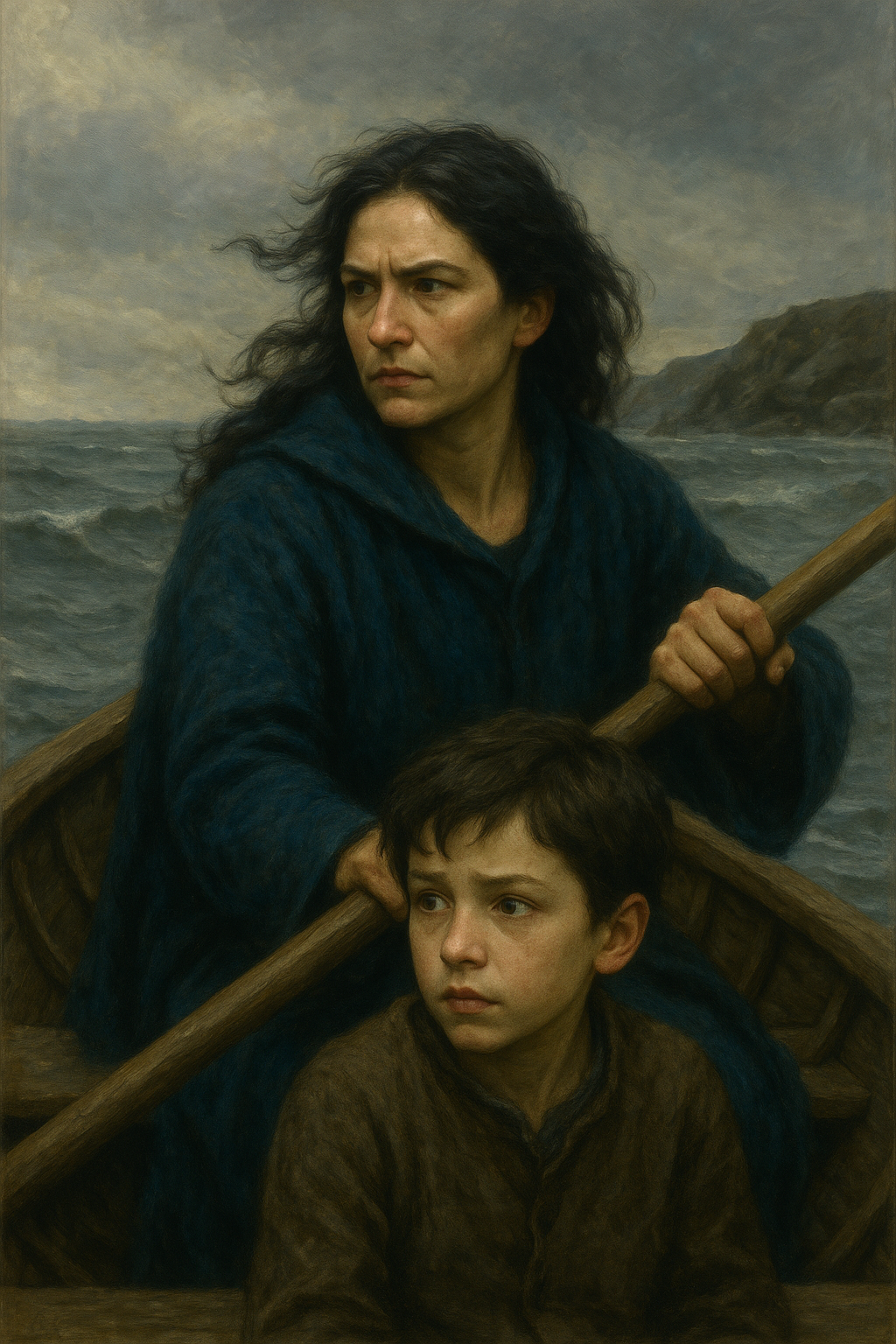
She didn’t stay with him. She believed he would be harder to find if she kept her magic from mixing with his. The less marked he was, the safer. When Kallhor was calm and content, his accidental power stayed quiet. The farm she found for him was peaceful, and gave him something to do — animals to tend, or simply watch.
The Netherlows didn’t ask questions. Ebran and Mags were steady, self-contained people. She paid in what she had — bundles of dried herbs, good woollen cloaks and stitched blankets, along with a quiet promise: “I’ll return before trouble, every time.”
Stellan stayed nearby. She began to search for a quiet sink in the land, somewhere she could go unseen but still be close. She was drawn to Fennick’s farm, and to Fennick himself — honest, humble, nothing like the boy’s father. After all she had endured, she wanted to heal. And when Harn turned out to be sensitive to disturbances in the Hum, it gave her a rare sense of safety.
She vanished into the rhythm of the land. But she watched.
She patrolled the edges of the boy’s world. When something shifted — a silence too thick, birds too still — she would call on old allies. Sometimes she’d send starlings to circle overhead. Sometimes she would cloud the area with mist drawn from the Shrouded Fens, masking the boy’s presence. The mist blurred not just vision but memory, and it made the magical scent of the boy harder to track.
She kept moving. Kept watch. And every few months, she vanished — no word, no reason. Sometimes for a day; sometimes ten. Her family never knew where she went, but they felt it each time — the shift in her presence, the pull in the air. It was as though she orbited something invisible and immense, drawn again and again to the quiet centre of a storm only she could see.
Stellan’s Protection of Kallhor
The Starling Watch
While Stellan tries not to use her abilities to harness beasts, she uses starlings to protect Kallhor while she cannot be with him. Their murmurations are message, memory, map — pattern as language.
For Stellan, they aren’t familiars, exactly. They’re witnesses. Responders. Not tame, but in resonance.
At dusk, after wishing Fennick a good night, Stellan stands at the field’s edge, eyes skyward. A swirl of black flecks coalesces — shifting like breath, like thought.
They don’t come on command. But when they come, they come in force.
- Murmurations become signs. The shapes speak. When the pattern curls tight and then shatters — danger. When they split and loop back — reassurance.
- A single starling veering out of formation might lead her, tumbling low, to a forgotten trail or a buried sigil someone has etched near the boy.
- She never calls them hers. But they call her the same way the wind once did.
The Starling as Memory-Knot
In the mythology of the Outer Wind islands:
- Starlings are knots in time — where the past gathers and flutters before dissolving again.
- They hold memory communally, and their movement is the mind of many.
- They’re said to remember those who spoke kindly to them in another life. Some believe you are reborn as a flicker in their flight.
Stellan’s Ritual Use of the Starlings
When she needs to hide Kallhor, she places a fen-token (a loop of dried reed and soaked moss) on a low branch, pricks her finger, and says:
“Scatter me wide, knot him quiet. Forget the thread, hold the boy.”
Later that day, the starlings appear in thousands, weaving their blur over the land. Skarn cannot track what has no line.
As well as The Starling Watch, Stellan devotes herself to her nephew in secret from everyone.
- Mistwatch
She has a circuit — known to no one — patrolling ley-points near the fens. Sometimes, she places one of her carved wind tokens in the marshes to stir the mist if crossed. - Astral Tracers & Memory Veils
She once met a wandering archivist who helped her create a charm to scramble the “scent” of astral lineage.- Uses shrouded fen water mixed with dried forget-me-not and elder root.
- Applied to thresholds and clothes. Occasionally burns it to release protective fog.
- The Black Blade
She crafts something — not a weapon exactly — but a ritual object for severance.- Blade of flint, pressed into unbinding and healing herbs (yarrow and wormwood) and crushed sloe berries. Buried in cloth to infuse for 33 nights.
- To clear away illusion, obsession, magical entanglement. It will not harm the body — only cut ties.
- She hopes one day to use it to separate Kallhor from Skarn’s magical tether, and to unharness the forces that wrack him.
- The Quiet Book
She records what she knows of Kallhor’s behaviours and signs.- It’s written in her sea-island tongue.
- Notes are coded into weather patterns: “Storming at noon after gulls flew — he was crying silently before I arrived.”
- Whispers of Resistance
She’s made contact — cautiously — with others who oppose the Evergild.- Perhaps a quiet alliance is forming: exiled fae, clear-souled humans, even sentient beasts.
When Stellan fears the end of her life is near, she passes on the protection of Kallhor to her son, Harn. It is the first time she has told anyone about him, outside of Farra. She entrusts him with the Blade and the Quiet Book. The weight of her love for her nephew pours onto the first page of the journal, written in fine charcoal script — rarely, reverently:
“There is a name he wears like deep stone wears water — not carved, but shaped from within. Kallhor.”
Stellan began the Book as observation. Harn annotated it in the margins with his own experiments in harmonics and pattern resonance. Towards the end of his life, he passes it to Old Foss, along with the dangerous truth.
Old Foss feels a tug of pity and responsibility for his kin, and privately and steadily looks for information through the years. While he is now a father, something he has found he feels duty-bound to follow, forsaking Lowen and Elowen. In case he didn’t return, he entrusted the Quiet Book to Willa, with solemn instructions:
“If I do not send word each midwinter, give this to Lowen. Not before. It must call to them first.”
As for the Blade, given to Harn wrapped in a waxed cloth lined with Stellan’s linen: he buried in a pot beneath the roots of a young birch.
One day, Lowen will hear the tale and dig in urgent reverence — feeling the outline of fingers in the soil, unsure if they are Old Foss’ or Harn’s.
The blade has a name in Stellan’s tongue, but it has not been spoken in many years. It is waiting.