The Braids were half-fabled, half-hidden. Few entered; fewer returned with the truth of what they’d seen. Old Foss went looking for them anyway, carrying the Black Blade and the Quiet Book, seeking Primavelda to cut the binding on his kin.
Chapter 1: The Braids
The smoke carried soft and low across the gullies, white threads tugged by the river-breeze. It was not sharp like sage, nor heavy like resin, but light, faintly sweet, with an echo of sun-warmed stone. The herb was one the Evergild had never valued: a climbing thing with pale flowers, grown only where cliffs faced south and refused shade. The Lessae once burned it at moments of giving, when all hands came to share what they had gathered. To find its scent here, blended with friendlier smokes, was to remember something they thought lost.
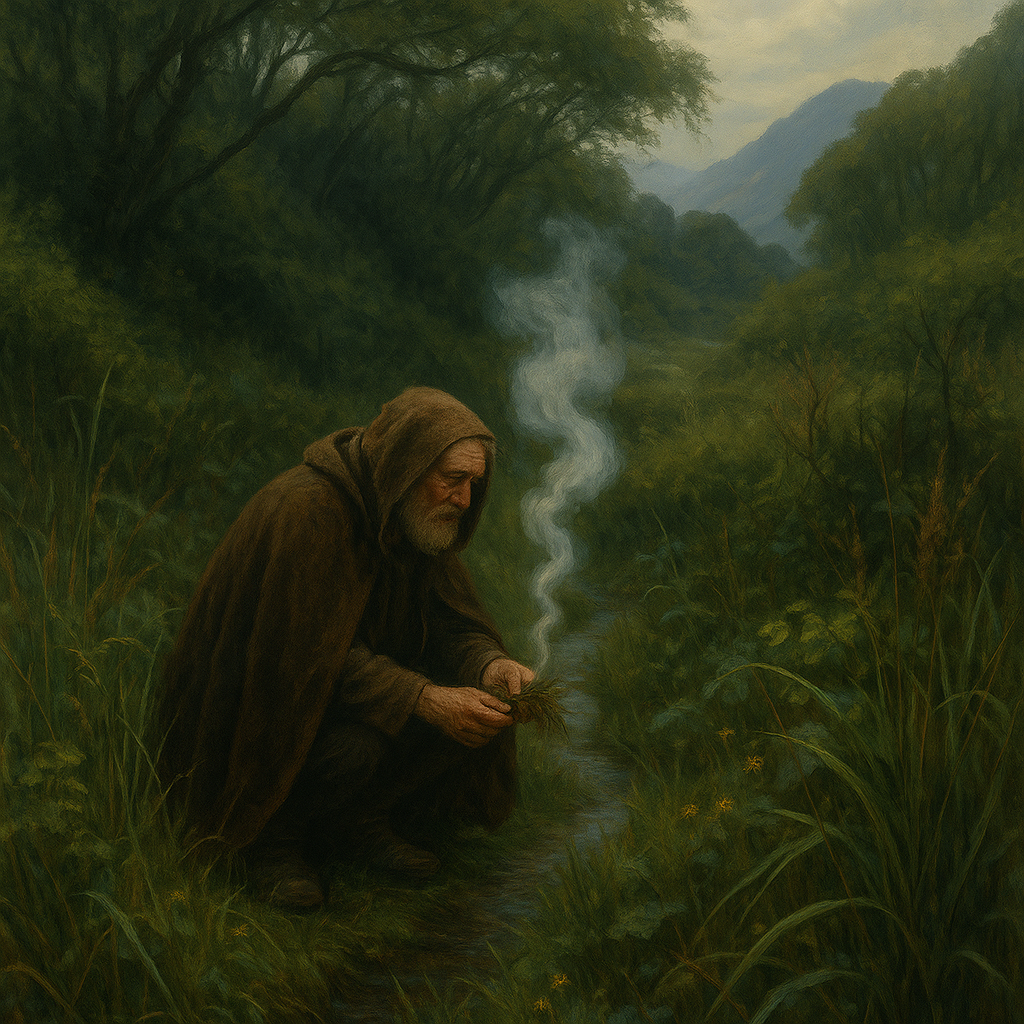
A young Lessae came at last, stepping from the thicket where the smoke drifted low. Foss had not been sure anyone would come, and for a breath he only watched, steady but uncertain of the welcome.
The young fae was bare-armed, quick-smiling, he moved like a reed that knew when to bend. He stepped from the undergrowth without stealth, tilting his head as if to catch more of the fragrance.
“Hello. My name is Orris,” said Old Foss. His voice was low, steady, offered like a hand. His mouth barely moved, but his eyes softened, his shoulders easy. Still, there was a watchfulness in him, as though he weighed the chance of being turned away.
“You’ve walked far to find the right mix. I am Pallan,” the young fae said, voice warm, unassuming. “Most outsiders settle for smoke that drives off midges, not draws in friends.”
Old Foss’ eyes creased with a smile, watching the pale drift. “Plants talk in words I cannot find.”
Pallan hesitated only a breath, then reached out and bent a spray of reeds, laying bare a strip of firmer ground between the roots. “Here,” he said, stepping ahead. His weight pressed lightly, never sinking.
Foss followed, careful, watching where Pallan’s heel left the brief print of safety.
The Braids were as secretive as the tales had claimed — roots folding into water, paths that turned back on themselves. Foss had wondered if they truly existed, until now. To be led in at all was an honour he felt in his bones.
As they went, Foss touched the leaf of a pale creeper curling along the bank. “That one’s new to me,” he said quietly. Pallan smiled, naming it as climbing hartvine, then pointing out another that thrived only in shaded gullies.
Foss listened carefully, repeating some names under his breath, measuring likenesses and differences. Soon they had fallen into a companionable rhythm, trading notes with easy warmth, and the young Lessae’s trust grew in the shade.
The way in was no straight path. Reeds leaned, vines wove, ground shifted soft underfoot. Pallan went ahead, pressing stems aside with an easy hand, showing where the ground would hold a step, or where to hook an arm round a leaning trunk to swing across a hollow. Foss followed, slow and careful, boots tugged by mud and reeds. It was less a walk than a steady picking-through, as though the land itself were testing each step.
Now, further within the Braids and close to the hidden settlement, the air felt changed — not heavier, but nearer, as if trees, water, and stone all leaned a fraction closer to hear. Foss felt eyes on him, though only Pallan walked at his side. Once, between the vines, he glimpsed a figure — Older, heavier in the gaze. He measured Foss like stone weighs water. Not hostile, not yet welcoming, but searching for balance.
Foss lowered his gaze politely, feigning surprise only when they would meet in truth. It was enough to show he had not been blind, nor unmindful.
“This is my father, Gràve,” said Pallan, with quiet weight. He stepped aside to let Old Foss pass.
Foss wasn’t sure of the greeting to use, so he looked him straight in the eye. “Orris Foss, of the eastern fens.” His voice was low, steady, without flourish.
Gràve returned his gaze and tipped his head slightly, as though waiting for the heart of it. Foss read it plain enough — a question of intent.
“I’ve kin bound wrong,” Foss said. “Born tethered to storm. I’ve journeyed near twelve years, looking for the cut that would free him. I heard Primavelda might make it.”
Gràve’s face did not shift, but the silence deepened, weighted, as if the thickets themselves were listening. He nodded slowly, offering his hand to help Foss through the last of the rough ground. “Come.”
They let him be for a time, though he knew curious eyes would be on him. Pallan kept him in good company, pointing out what grew in pockets of shade or on the higher ridges, naming plants Foss had never seen. Foss touched leaves and runners, longing to pluck and press them. He crouched over a fern whose fronds curled like question-marks, peered at a cluster of pale bulbs nestled in moss, bent close to the small, delicate flower of climbing hartvine where it crept across the bank.
The awkwardness of being watched never quite left him, but the plants won his attention. He found himself speaking softly now and then, offering what likenesses he knew, though not as teacher — more as one who could not help but answer when shown something alive. Pallan listened, pleased, and added his own knowledge.
For Foss, the strangeness of the Braids did not fade. If anything, it deepened. To be here at all was an honour, and he felt it in his bones: this place was different, liminal, held apart from the world he knew. He moved with care, each step a reminder that he had been allowed in.
Primavelda waited where the vines had knotted themselves into a living wall, still as if she were part of it. Gràve and two more of the Lessae lingered close by, quiet as moss. The place was chosen well: nothing could be spoken here without the tangles pressing in their reminder.
She had introduced herself with a question — “You are seeking me?”
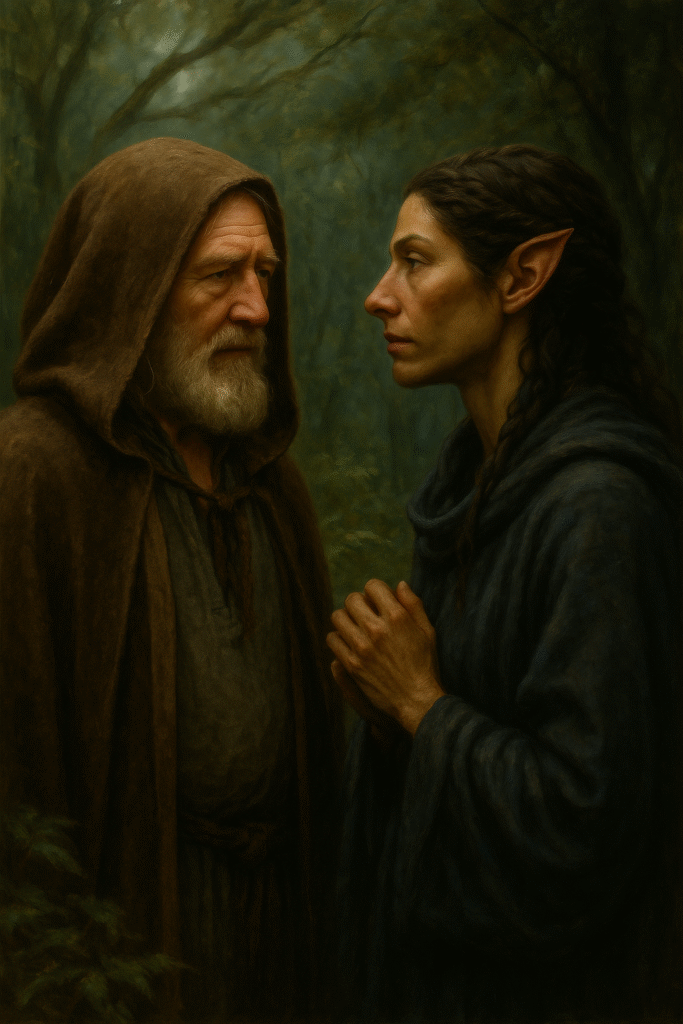
Foss had been struck by her stature, the poise in her bearing, the hard set of her face. He felt the strength of her craft before she spoke a word. It struck him with a weight he had not expected, and with it, a thrum of hope.
Foss bowed his head slightly, drawing no more smoke from his pouch. I’ve walked twelve years,” he said. “Seeking answers, finding only more. Digging down, and the roots still twist. A wretched fae called Skarn bound my blood-kin before he was born, tied him to storm and sun, left him no breath of his own. I’ve come to cut that tether. Alone, I’ve not the strength. But I’ve heard your name, Primavelda. Unbinder. I ask you.”
The leaves stirred though no wind had reached them. Primavelda’s eyes fixed on the blade when he set it down, its dark edge wrapped in cloth, humming faintly with what it had been made to sever. She did not touch it yet.
Gràve’s voice was slow, weighty. “Skarn meddles with nature. We have felt it before. Still we ask — why should we tie ourselves to your cause? A tangle cut can draw both ways.”
Old Foss lifted his gaze, calm, steady. “I don’t come empty. You know the Evergild’s maps. Too much of the world is theirs to draw, and yours to vanish from. I’ve a cousin who works their maps in the House of Coin. If you ask it, I’ll see your lands drawn otherwise — blurred, turned aside. No more curious markers drawing the wrong eyes.”
The offer settled like seed into soil. One of the listening faces softened, eyes bright with quiet hope; Gràve’s narrowed, weighing.
Primavelda cut the silence. “Not every knot will loose. Some have eaten the cord. Some are the cord.”
Foss’s chest sank. The truth of it struck him — too close, too possible. He drew a breath, and nodded.
Then Primavelda rose, her motion like a blade unsheathing. “We’ll go,” she said. “For him, and for the wound Skarn made. Bring me to your kin.”
Her gaze flicked once across the circle, and Foss saw another’s eyes meet hers — steady, unreadable, as if the answer had already been agreed. Only then did he understand she was not alone in this.
The vines above them trembled, a shadow of thunder far off, as if already answering.
Chapter 2: The Unbinding
They did not begin at once.
Primavelda chose a place apart, where stone jutted through the soil and the air moved restlessly, as though the weather had been waiting. A low hovel leaned into the slope, roof heavy with moss. Foss thought they might go inside, but Primavelda shook her head. “Too tight. Storm needs sky.”
So they worked in the open.
Kallhor was waiting. He looked older than Foss remembered — his frame gaunt, his eyes dim — and yet there was still a strange charge about him, a hum in the air that raised the hair on Foss’s arms. It was the binding, the storm caught in his blood. Foss’s chest tightened.
The Black Blade, carried through three generations and never the dare to wield, lay across a flat stone. Foss unwrapped it carefully, fingers steady though his chest ached. Primavelda bent over it, her voice low, testing its weight. Florivane, the lessae who came with Primavelda, set out jars and bowls, pigments gleaming faintly in the dim light.
And Foss worked with a fervour that broke his usual placidness. He crushed resinous bark and bitter leaves, smoking the air to steady breath. He laid out roots for strength, petals in geometric lines for composure. With his pestle and brass bowl, worn smooth from decades, he raised a sharp, clear scent that held back the choking heaviness of storm.
When Primavelda reached for the Quiet Book, he set it open for her. She traced the marks her kind had never used — the old runes, rough-cut, human-born. “Strange,” she murmured. “Yet true.” Foss showed her where to carve them, not into the body but into the soil around, a ring to steady what would break loose. His hand knew their shape without need of the page.
Kallhor waited, frail, silent, the storm still humming in him. Old Foss looked on and saw the centuries of a life bound wrong. He thought of his own lost years — Elowen, Lowen, all he had set aside. The thought near broke him. He set it down like another tool on the stone.
When all was ready, Primavelda spoke, gaze fixed on Kallhor. “I feel the shape of the knot — too much.” Her words shot anger into the thick air.
Foss bowed his head, throat tight. Florivane’s warm hand settled on the small of Foss’s back, grounding him.
Primavelda spoke a final warning. “Clouds break, and air bronze.”
Then she lifted the Blade.
It began rough. The Blade struck what was unseen, and thunder answered. The sky thickened, light bruised. Florivane steadied Kallhor, her hand at his chest, warm breath at his ear.
The storm lashed. Lightning split a tree nearby, its crack searing the night. Primavelda pressed on. Each stroke of the Blade fell on the binding, as if carving through sinew, though no flesh was touched. Sweat shone on her face, her sleeves scorched where sparks leapt. Florivane’s pigments bled across her palms, burning into her skin.
Kallhor arched, eyes rolling back, a croak rising deep in his throat. He gasped but no breath came. His body jerked, limbs thrashing against the unseen tether. Foss pressed herbs to his skin, whispered runes into the soil. He could not cut, but he could hold.
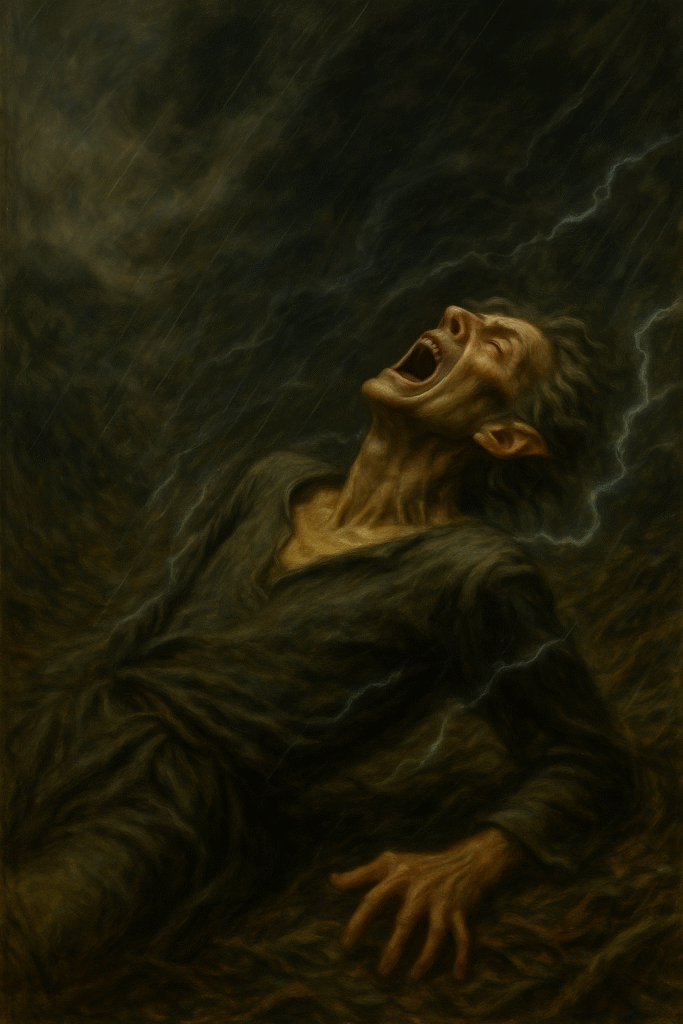
The work dragged long. The air thickened until even Foss’s lungs faltered, the storm pressing into him as if to drown him. Primavelda staggered once, her hand burned raw where the Blade met resistance. Florivane poured her voice into the wound, breath and song, pigments streaking a cloud across his belly. Still the knot held.
Then the final cut bit deep. Only then did the Blade bite skin, scoring him at the navel, where the tether first passed into him. A scream tore loose — Kallhor’s, or the storm’s — and then silence cloaked his body.
Foss’s heart stopped. Kallhor’s chest fell. For a breath, two, three, Foss thought it had ended — that they had broken the cord entire.
Then came the faintest stir. A breath. Another. Quiet, steady, peaceful. His body slackened, not in death but in release, as if centuries of weight had at last slipped away.
Foss fell forward, tears leaping from him. He pressed his wet face to Kallhor’s hand, lips to rough skin. He could not speak thanks. Not yet.
The rain began — a few fat drops at first, then more, falling heavy, running through his hair, striking stone and earth.
Primavelda knelt on one knee, the Black Blade still gripped in her blistered hands, eyes dark as she looked up at Kallhor. She seemed to see past the veil that had covered him, measuring the change.
Florivane’s palms glowed faint with pigment, skin scorched but steady.
No one stirred. Reverence held them still. It was as though a great stone had been lifted from the chest of the world.
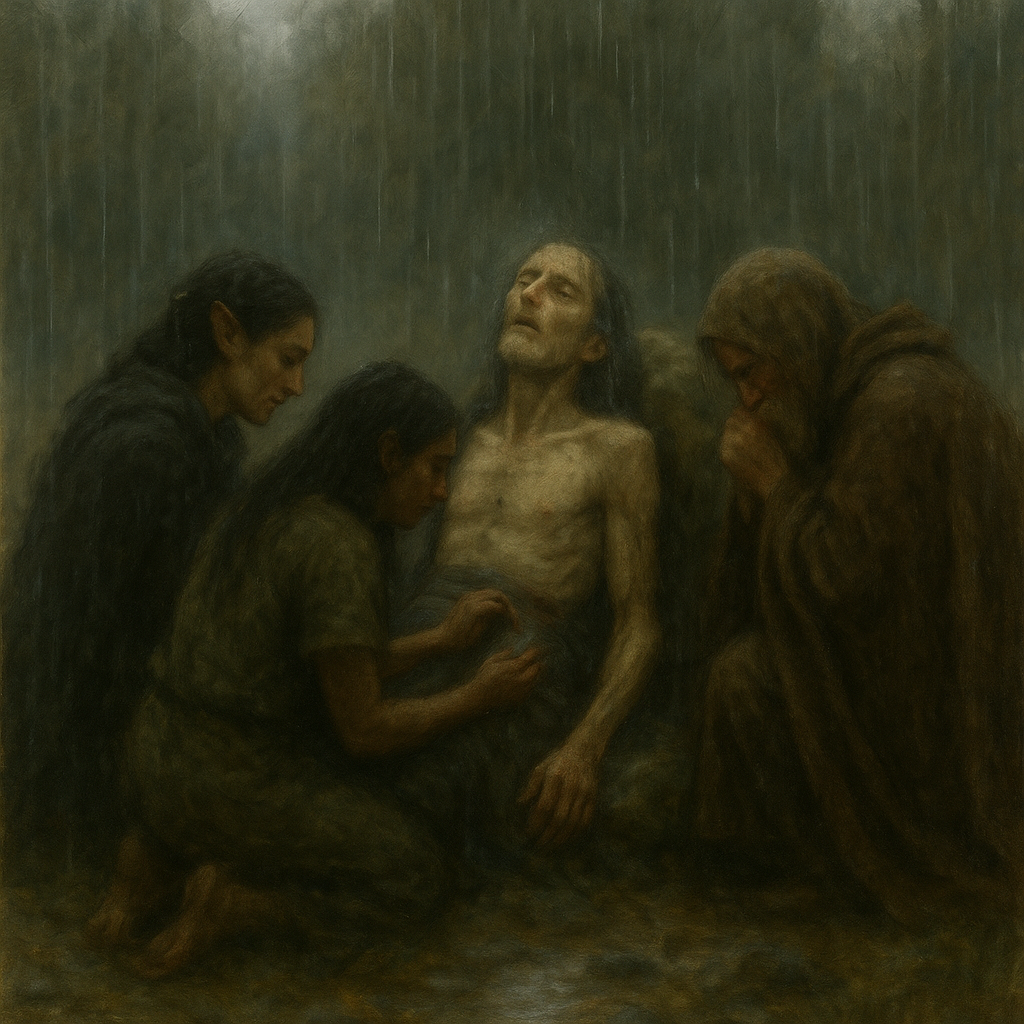
Foss wept openly now, weight gone, shoulders bowed. For the first time in twelve years, he felt dawn-light drop rays upon his soul.
The rain thickened, drumming them clean. They began to move; with reverence, not triumph. Primavelda wiped the Blade with care, cloth sticking to the seared edge. Florivane worked quietly. She blew her breath into the cut, then pressed a living tincture to the wound — resinous and bright, seeping like sap, renewing, sealing warmth inside.
Then, with her pigments, she marked him. She chose from the Quiet Book a rune that felt most like nurture, like mother — though its shapes were strange to her hand. She painted it onto his palm, believing it would carry the touch he had never known. On the other hand she drew the curve of a wave — the river within him, freed from stone.
Foss saw the rune and felt his breath falter. Cloud. Kallhor’s mother’s mark —Cirra’s stone. A quiet shock moved through him, like another knot cut free.
The rain poured harder, running off their faces, off the stone.
And Foss felt the echo then — the rune, the storm. Cirra, who had never smiled upon her son, now touched him at last. Each drop was her hand on his brow, her fingers across his face. The rain anointed him as she would have — with spring water, with chamomile — the blessing no one had given her precious lost boy.
Kallhor drew breath beneath it, and for the first time in his life it was not a storm that moved through him, but her love.
Mother and son were loosed together. She, from the torment of what was done; he, from the tether that bound him. In this new freedom Foss felt the truth of Kallhor’s name. Within rock, a current runs — now it ran free.