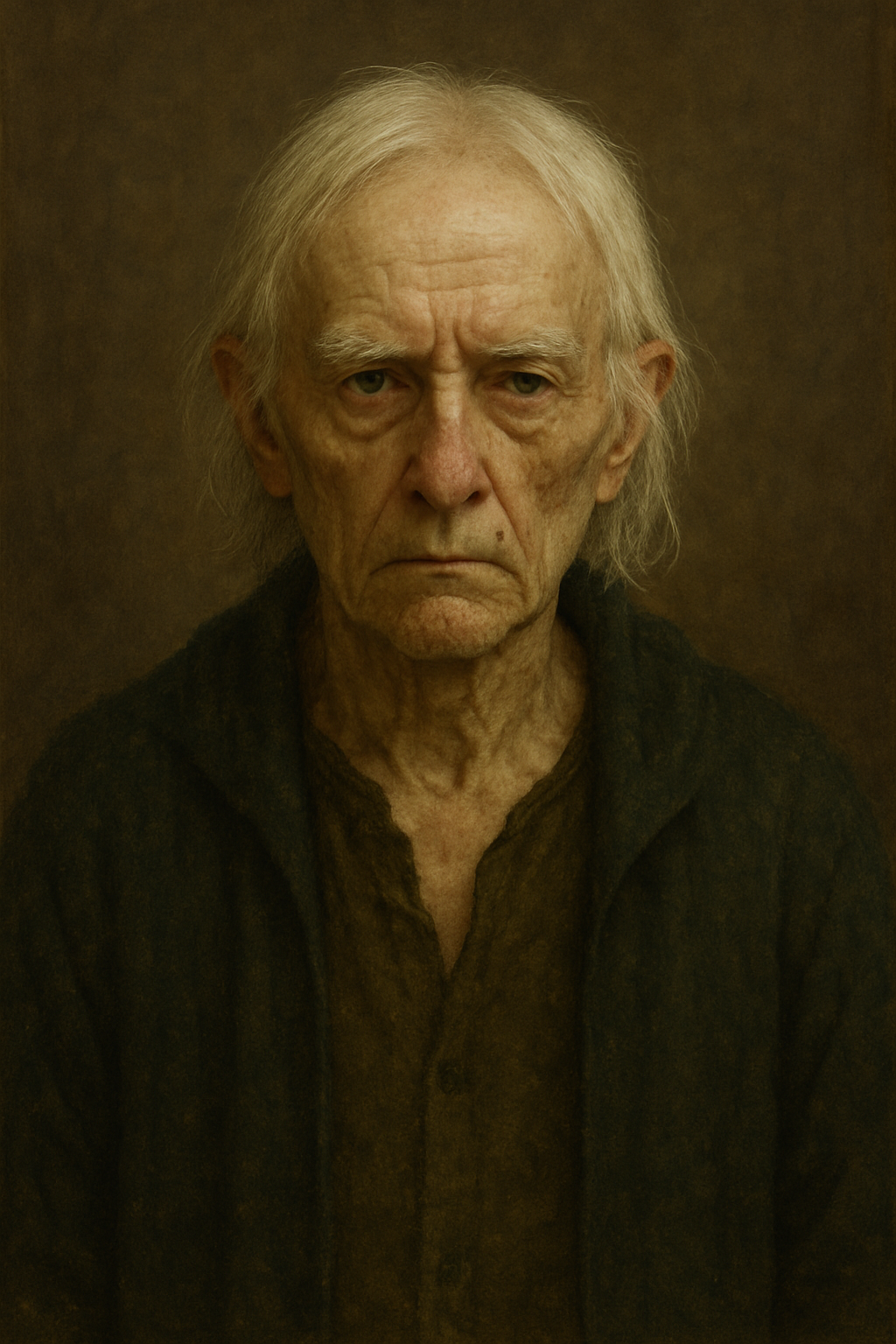
Thin and drawn, with lank, chin-length hair that hangs damp with the weather or sweat, he carries the smell of dried leaves and something slightly metallic. His sallow skin is mottled with liver spots, and one dark mole near his cheek stands out like a smudge. One of his eyes is clouded and pale—the other sharp, too sharp.
He walks like someone who’s forgotten softness. Not cruel, but taut with unprocessed grief. His voice has a bite to it, especially when tired or pressed, though a quiet protectiveness lives underneath. He loves his family, fiercely, in a way that sometimes cuts before it comforts.
He has a wound and it keeps him bristled. He speaks in short, bitter bursts, but his knowledge runs deep.
He’s the kind of man who might offer you tea with one hand and a cutting remark with the other. But if he sees you in true need, he’d sit in the dirt beside you until you found your feet again.
- Magic: Harn’s gift is a watchful magic — quiet, perceptive, rooted in stillness. Like a heron, he stands and sees. Not all movement catches his eye — only what is out of place. His sight is tuned to disruption: a rhythm that breaks, a hum that turns. Over time, even predictable change becomes background to him, but an off-key flicker draws his focus like a thread tugged too tight. But he also sees positive anomalies: the unexpected harmony, the rare glint of rightness where none should be. A sapling blooming too early. A healing that happens too fast. A moment of joy in a place of grief. These register like sudden music in his bones.
- Bitterness: Harn never trusted the Evergild. He saw them as meddlers cloaked in order, manipulating the hum under the guise of stewardship. When Tauren joined them, Harn felt betrayed — not just because his brother aligned with them, but because he knew Tauren could feel the same wrongness he did. Worse still, Tauren recruited Orris, Harn’s own son, into the gardens. That hurt turned inward and soured him. He spoke in fewer words after that.
- Relationship with Orris: Despite the hurt, Harn never stopped loving Orris — nor Orris him. Orris remained open, even cheerful, as if his father’s sharpness glanced off his spirit. Harn resented the influence of the Evergild, not the son who walked its paths. There was affection between them — guarded on Harn’s part, steady on Orris’s. A love with silence inside it, but not absence.
- Discomfort with the Evergild: Harn saw the Evergild’s hand creeping across the region — regulating what once ran wild, tidying what never needed taming. He felt the hum grow thinner, more brittle, as the weight of their rituals pressed down on the land. His mistrust wasn’t theoretical — he felt it in his bones, in the soil. But he could never get far enough to prove it.
- Drawn to Sorrel: Sorrel was Harn’s counterbalance. Where he watched, she moved. Where he brooded, she breathed. He was drawn to her not for relief from his tension, but because she gave him space without trying to fix it. She never feared his silence. She met it with open hands, a meal on the table, and a rhythm strong enough to lean on. Loving her didn’t unravel him — it grounded him.
