
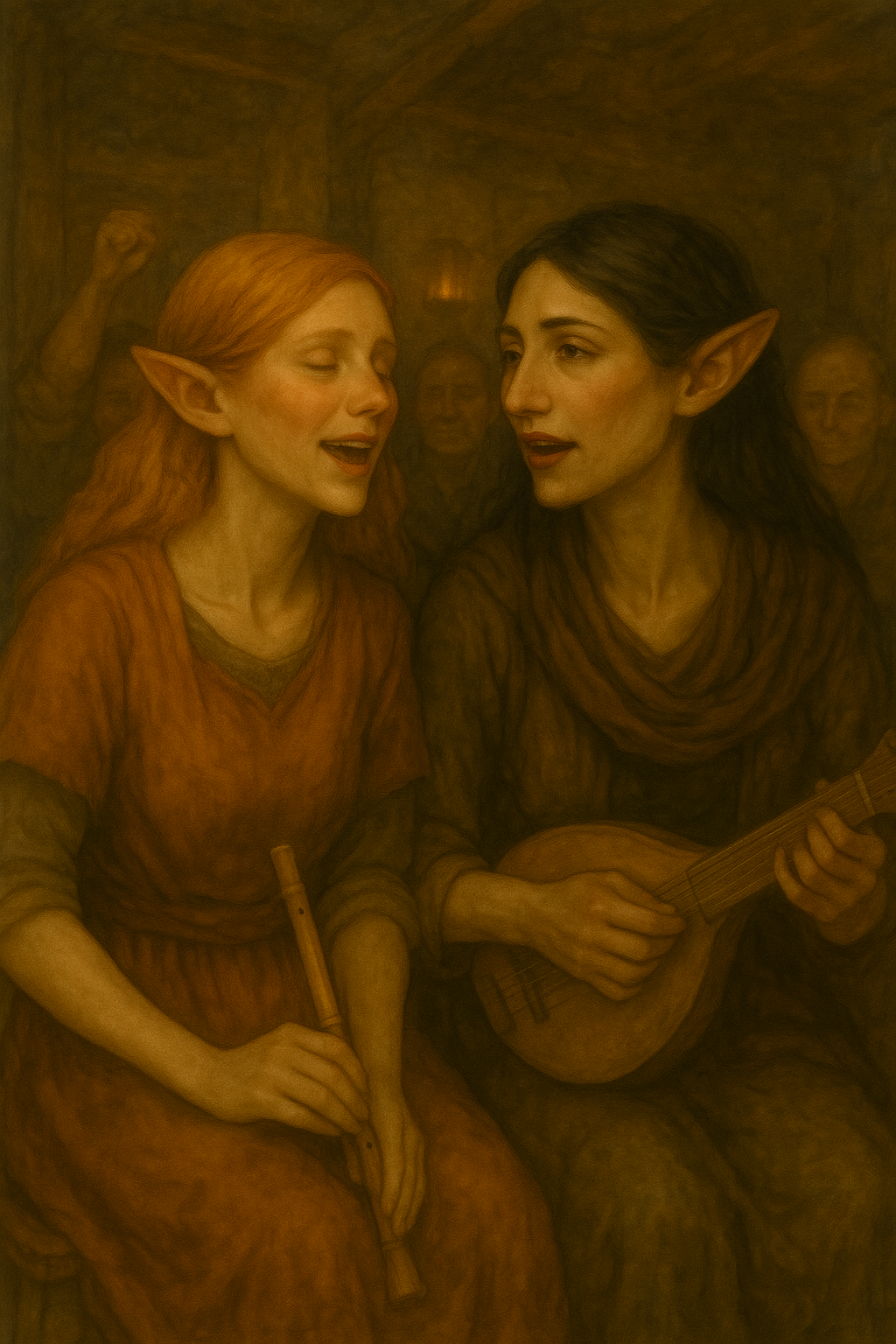
The Clavaine Sisters (Aessa and Mae Clavaine) are Lessae musicians of quiet renown, known not by banners or proclamations, but by the way conversations hush when their music begins. Neither plays to dazzle, but both command a space without asking. Their songs move like weather—gathering slowly, touching deeply, then gone.
They are most often found in in-between places: at the edges of markets where they do not quite busk, but offer; in the benches of wayhouses where folk listen with their backs to the hearth; at feast days, weaving sound between jugglers, vendors, and fieldfolk. Some say they have been heard beneath trees at dusk, where the woods lean near to human roads—but those who find them there rarely speak of it.
They play a shifting array of instruments: lap harp, reedpipe, drum, cittern, the occasional crwth, and a mouthbow when the mood turns strange.
Mae, with rust-warm hair worn loose, is the lead singer. Her voice is quiet but cutting, like something remembered more than heard. She plays the reedpipe most often, moving between instruments with unspoken instinct.
Aessa, soot-haired and slightly older, shifts between rhythm on the drum and quiet melodies on strings. She joins her voice to Mae’s in perfect unison, never harmony.
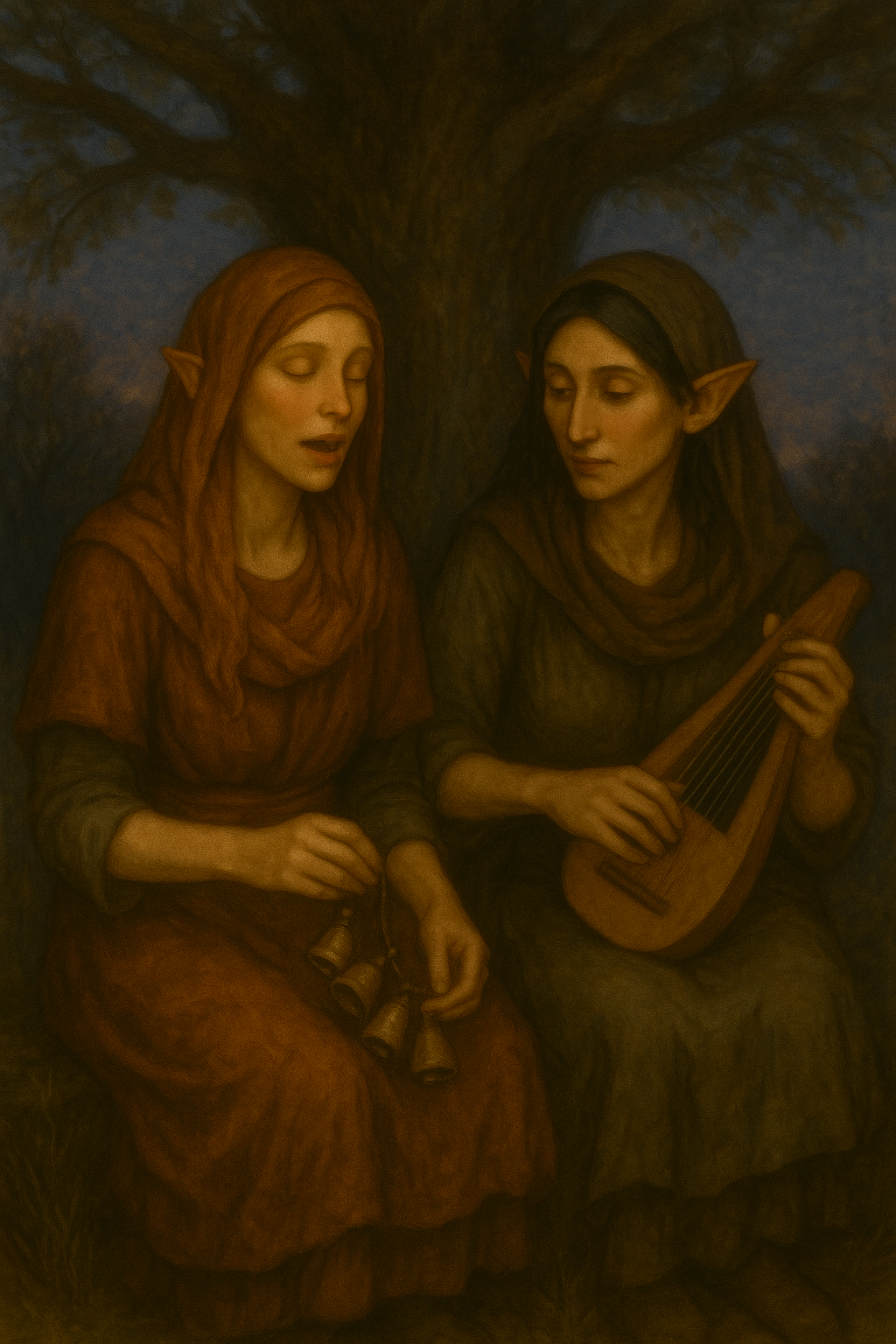
They are instantly recognisable to those who’ve seen them: slight, with heart-shaped faces, long noses, wide-set cheekbones, and dark eyes that flicker like oil lamps in wind. Both wear clothes that, though simple, speak of intention: a scarf knotted just so, a wrap re-dyed and overstitched. Their presence is never forced, but it lingers.
They don’t belong to any troupe. They travel without heraldry or fixed route. But word of them spreads like threads caught on hedgerows: remembered songs, a verse overheard, a story that hits a little too close to truth.
Their songs are not for glory. They are for memory. And sometimes, for warning.
Known Songs
The Wild Has Run – A ballad told in verses, carried by the Clavaine Sisters in still corners and dusk-lit inns. It follows a free-roaming horse through the ache of choosing safety over the wild—and the deeper ache of returning too late. Told by a narrator, with lines from the horse voiced quietly by one sister. The final verse lands like a call or a prayer.
Hooves on river stone, breath like steam,
He ran where bramble tore the skin.
Through biting winds and bare-limbed woods
The rock was hard. The cold went deep.
“Still, I ran. I ran.”
He saw the others turn aside,
To the Beastcallers, waiting,
Hands outstretched with quiet voices,
Shelter, hay, and gentled touch.
“Not I,” he thought—and ran.
But the fields grew still, the sky turned grey,
And hooves no longer answered his.
The trees stood bare, the ground was stone.
The wind brought nothing to the ears.
“To the Beastcallers must I.”
He hauled and bore and learned the shape
Of harness, gate, and softened voice.
The cold stayed out. The hunger passed.
And colts were born in beds of straw.
“The grass is sweet. The pain is gone.”
“I came here running,” once he said,
“But now I’m stilled, and yoked, and fed.”
He turned his head toward the west,
The hills beyond the lowland line.
“But the wild has run from me.”
At dawn, he faced the wind and leapt,
To drive the rhythm into stone.
Stark beneath the unshadowed sky,
He split the silence with his cry—
“Run with me, the wild.”