History and Reputation
Gotts Keep is a formidable river city, climbing the slope above the River Gornd. In recent generations it has taken on a restless energy — workshops humming, new metalwork rising, a confidence in trying what no other human city has thought to attempt. While the well-off river cities polish Evergild-approved styles and repeat what sells, Gotts Keep follows its own instincts. Its builders favour cleaner lines, sharper turns, and mechanisms no handbook recommends — a human style forged by people intent on shaping something that wasn’t handed to them.
The old city is still there beneath the new shine. The earliest streets twist in defensive spirals, their corners tight and steep, reminders of harder years. Narrow runways slip between buildings, once used by runners and scouts or for moving food quietly when it mattered; now they simply belong to the rhythm of the place. Wider squares open out toward the centre, where guilds, traders, and workshops gather. Forges that once rang with weapon-making now serve quieter purposes — architectural metal, hinges, chains, fittings for bridges and civic works — though the heat and hammering feel much the same.
You can still see the bones of the past in the layout: workshops built over the outlines of old watch-houses, armouries long since turned into storehouses for builders and craftsmen. People here carry a habit of readiness — not fear, just a way of reading streets, doors, and crowds that seems woven into the place.
Gotts Keep is governed, like all human settlements, under Evergild authority, yet its character is firmly its own. Along the river, Tellerwick keeps a close hold on its taxes, Denerin is keen to claim a share of its rise, and traders treat its fittings and mechanisms as the standard to meet. The city’s reputation is one of quiet prestige, self-reliance, and inventiveness.
Gotts Keep has its history — you can feel it underfoot — but its attention is forward, and its ambition is very much its own.
City Structure
The Flue Network
Beneath Gotts Keep runs a dense web of stone-lined flues, some dating back to the city’s earliest forges. These channels pull smoke and heat sideways and uphill rather than straight into the air, creating a steady draught through the workshops on the mid-slope. Settling chambers along the way catch soot, which is harvested for ink, dyes, polishes, and soil amendment. The network ends high on the hillcrest, where the final warmth and fumes disperse into the wind. It is not a single planned system so much as a centuries-old habit of reusing and connecting whatever channels already existed.
Use of Forge Heat
The heat drawn through the flues is borrowed in several places before it escapes uphill. Workshops along the middle tier pipe warmth into drying lofts, curing rooms, and their more delicate craft processes. Further upslope, some houses take what little heat remains to keep cold rooms temperate through the winter. At the crest, where the flues end beneath the soil, the warm ground supports hardy crops and out-of-season herbs. The system is crude, practical, and never perfectly clean — but it saves fuel, supports trade, and gives the city a quiet advantage.
Hillside Layout
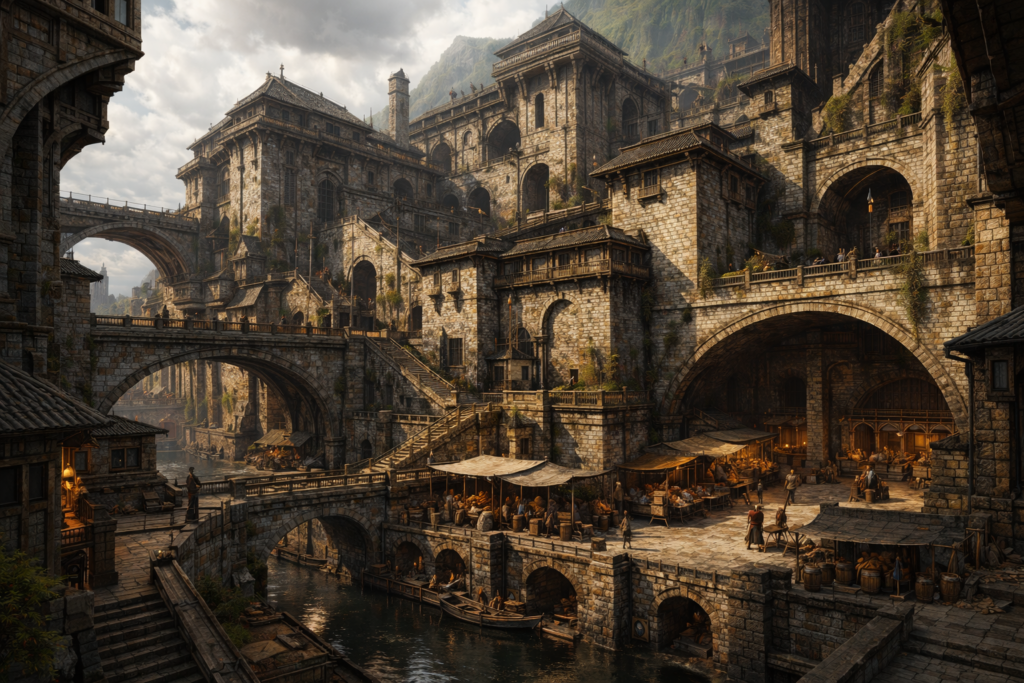
Gotts Keep rises from the river in a set of uneven terraces carved by need rather than plan. The lower tier is broadest, catching trade, workshops, and storage yards. Above it, the ground steepens; buildings lean inward as the lanes tighten, creating a sense of being channelled upward. The uppermost terraces hold council buildings, wealthier homes, and the remains of the old gate-structures. From almost any point in the city you can look downhill to the water — a long sightline guarded by custom, not law.
Defensive Spirals
The oldest part of Gotts Keep still follows its original defensive logic: narrow lanes twisting in tight spirals and switchbacks. They turn sharply, rise abruptly, and often lead travellers in loops before letting them through to the next tier. These streets were built to slow intruders, obscure numbers, and give defenders the advantage of height. Today they simply form the city’s most intimate, idiosyncratic routes — frustrating to visitors, second nature to residents.
Footbridges and High Lines
Across the old spirals, footbridges link buildings at every imaginable height. Most have timber decks braced with iron or angle-beams, and simple rope railings unless the span demands more. Over time these walkways have grown into a second circulation layer: a web of passages above the street, used for shortcuts, sending messages, stabilising hillside buildings, or simply hanging washing in the wind. Some bridges tilt upward with the slope, others cross between mismatched storeys, and a few carry small hoists or pulley-lines for moving loads. They give the mid-city its distinctive silhouette and sense of vertical life. In recent decades, several structural innovations — some pioneered by the metallurgist Irma Vire — have allowed builders to extend walkways and upper tiers with new confidence.
Building Materials
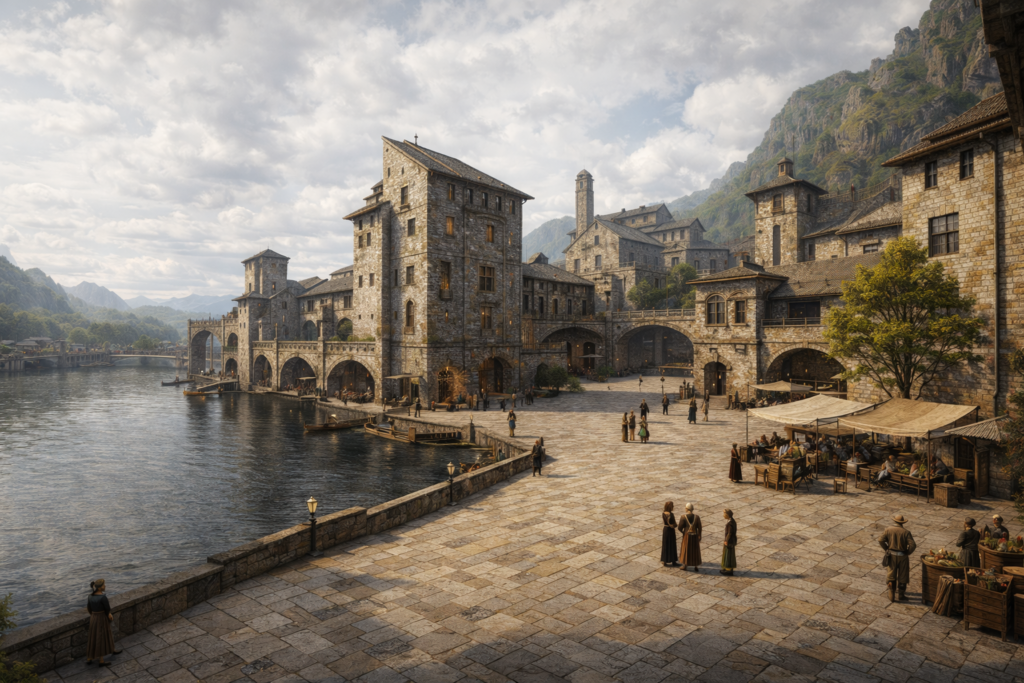
Gotts Keep’s palette comes from the land around it. Ironstone forms the lower courses of buildings and the footings of bridges — warm, dense, and resilient. Above that, walls rise in grey limestone, cut cleanly into blocks that suit the city’s angular style. Flint appears sparingly as rectangular panels, under-window bands, or lintel accents, not as full decorative schemes. Timber frames and upper storeys darken with age, while iron fittings and braces sit bare against the stone, their purpose left unapologetically visible.
Signature Architectural Grammar
The city favours hard lines: squares, rectangles, parallelograms, and long planes of stone broken by the occasional flint patch. Curves are rare and usually relics of older work. Newer buildings show a preference for straight spans, sharp joins, and visible structural honesty. Bridges and walkways use triangular bracing. Windows sit in simple stone frames with minimal ornament, sometimes underlined by a thin band of flint. The overall effect is a city that feels cut rather than carved — engineered rather than embellished. It is distinctive without trying to be grand, and recognisable from the first glance up any of its narrow, rising streets.
Peoples
Gotts Keep is home to two distinct peoples: the native Ormats, and the Dinians, who arrived in number after the violent destruction of large parts of the city, when a third force swept through the region and left whole districts broken or abandoned. The Keep took in refugees reluctantly. Space was made. Work was found. Streets were rebuilt. Markets reopened.
Over time came marriages, shared labour, shared losses. Integration happened without ever quite becoming unity.
The peoples live close. Housing blocks are mixed; your neighbour upstairs or below might be either. Children play together in the streets. At dances, lines blur more than anywhere else. But meals are still mostly eaten among one’s own. Voices soften or shift depending on who is present. There are rooms you relax in, and rooms you measure yourself in.
Some things are quietly adjusted rather than forbidden. Fairer hair is covered by choice. Names are shortened or softened. Southern dialect slips away in public and returns at home. Songs are sung that others half-know and half-forget. None of this is enforced. It is accommodation rather than oppression.
Certain traditions hold firm. Ormat pride and autonomy resist full blending; their ancestry remains distinct even generations on. Many Ormats design and build the city, engineer its hidden systems, and handle major trade through the river harbour. Dinians more often provide the city’s social glue: caring for the poor and sick, keeping kinship networks intact, standing behind common stalls and familiar wares in the markets. These are tendencies, not rules, but they are visible if you watch.