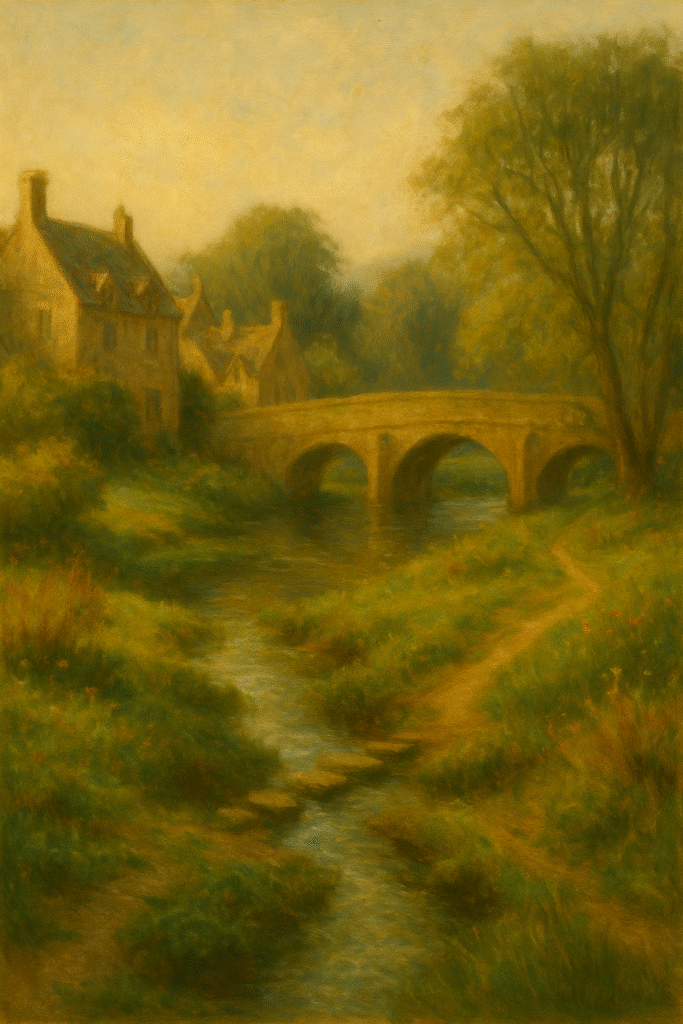
Tucked into the gentle folds of central Gildraen, on the eastern side of Lindral Citadel, where the hills begin to lean and scatter — lies the Evergild village of Mellwain.
Its slate-roofed buildings cluster beside a shallow river, crossed by a long stone bridge arched with age. A clear-banked stream wends its way through Mellwain’s outer fields, threading between herb gardens and orchard plots before folding quietly into the river.
Its course is slow, steady—sometimes marked by stepping stones, sometimes lost in the grasses—yet always present, like a breath beneath the day. The path into Mellwain curves past groves of walnut and ash, and the air smells often of mint, thyme, and the resinous warmth of drying herbs.
Mellwain is known for one thing above all: its gardens. Not for beauty — though they are not without it — but for purpose. These are cultivation grounds of fine regard, maintained by both humans and fae, and supervised by the Verdant Order. The herbs here are not for soup nor scent, but for patterning into potent workings — used in Evergild inscriptions, charms, and rites (though no local would call them that so plainly). Everything grown is grown for a reason.
The town’s structure reflects this blend of quiet diligence and quiet control. Herbalists and herbmasters live in shared lodging houses along the riverbank or within the manor compound itself — not peasants, but always reminded of their place. The Evergild maintain residences here too, though nothing ostentatious: pale-stone villas, a quarter-spiral tower with latticed windows, workshops tucked between formal gardens.
It is not the finest of Evergild postings — but it is not a poor one either. There is room for thought, for long walks on paths that wind through hazel copse and lemon balm hedges. There is structure, and a kind of held silence. Many who come here stay longer than they intend.