The By-Bow Almanac

A Brief and Bitter Survey of the River Settlements; a guide.
Compiled by Thistledown Quillweaver, travelling writer, neutral observer (mostly), and former lover of a Butter-by-Bow postmistress (still sore).
ON THE RIVER BOW
The River Bow is a winding watercourse that stretches from the whispering headwaters of the Fens to the gilded shadow of Lindral Citadel. It is, by most sensible definitions, one river. But to the settlements along its banks — each proudly suffixed -by-Bow — it is a fractious deity, a regional identity, a love song, and a centuries-old argument.
No one agrees how to say it.
No one agrees who said it first.
No one agrees it’s funny (though it absolutely is).
SETTLEMENTS OF NOTE
Butter-by-Bow (“Bough” like cow)
Sweet-faced and milk-stained, this village is famous for its butter, gossip, and passive-aggressive embroidery samplers.
Slogan: “Smooth as our churn, sharp as our tongue.”
Feud: Bitter-by-Bow.
Annual Event: The Salted Butter Pageant — think beauty contest, but for dairy and moral fortitude.
Bitter-by-Bow (“Bow” like ribbon)
Their wells run deep, and so do their grudges. Known for their bitter greens, bitter ales, and bitter everything else.
Slogan: “Life is bitter. So are we.”
Feud: Butter-by-Bow, and occasionally the concept of joy.
Annual Event: The Great Lemon Soak — unclear if celebratory or punitive.
Bow-by-Bow (“Boo” by “Bough,” officially. Unofficially? Chaos.)
No one visits on purpose. No one leaves on time. No one agrees on the pronunciation — not even the locals.
Slogan: “We are who we are. Are we?”
Feud: Themselves.
Annual Event: The Festival of The Third Bow, which raises more questions than it answers.
Ballad-by-Bow (“Boh” like show)
Dreamy and dramatic. Folk music haunts the reeds. Swans are involved.
Slogan: “Every heartbreak deserves a verse.”
Feud: Anyone who mocks their lute-to-citizen ratio.
Annual Event: The Weeping Reed Festival, where sad songs are judged by actual river eels.
Butter-by-Bow (Lower) (“Boh” like slow)
Technically part of the original Butter-by-Bow, they split some years back, during the Great Butter Pronunciation Schism.
Slogan: “Lower, but correct.”
Feud: Everyone.
Annual Event: The Clarified Debate, involving long speeches, heated cream, and one ceremonial cow.
Mire-by-Bow (“Mee-rah by Boo”)
Fog-bound and mumbling. Cartographers get lost trying to draw it.
Slogan: (undecipherable due to moss)
Feud: Not known. Possibly an ancient spirit.
Annual Event: The Sinking, wherein a wicker chair is slowly devoured by peat.
A NOTE FOR COURIERS
If delivering post:
- Blue ribbon seal = Butter-by-Bow (Upper)
- Gold wax = Butter-by-Bow (Lower)
- Single cow hoof stamp = Bitter-by-Bow
- Scented parchment = Ballad-by-Bow
- Envelope humming = Mire-by-Bow (just drop it and run)
ONCE AND FUTURE MAPS
Cartographers are advised to:
- Bring an umbrella.
- Ask for pronunciation three times and take the second answer.
- Do not comment on the butter.
LOCAL SAYINGS
- “You’ve got the Butter look, but the Bitter tongue.” – A backhanded compliment.
- “Lost it in the Bow.” – Used for anything gone astray or emotionally complex.
- “Don’t bow in Bow-by-Bow.” – Traditional warning for travelers.
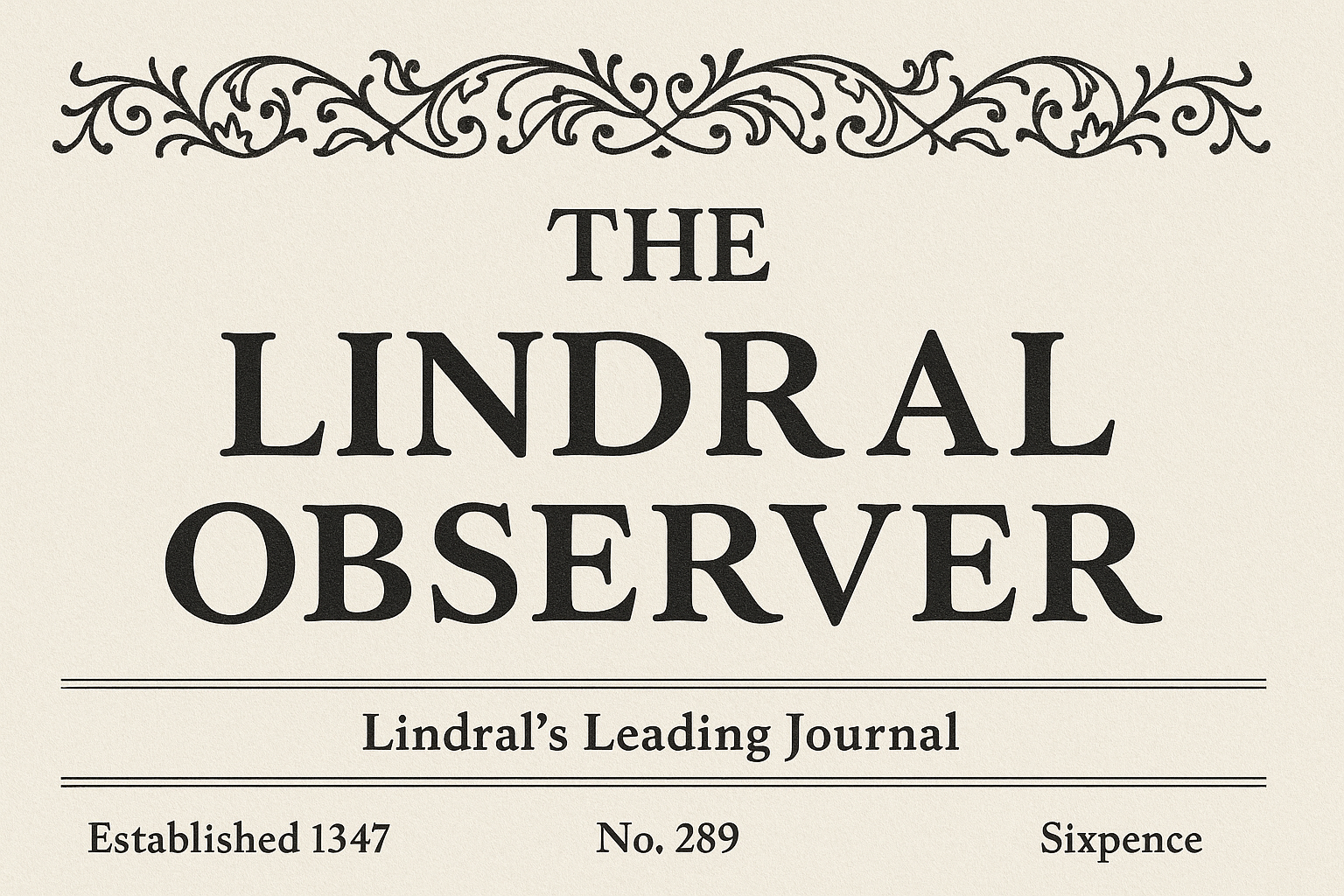
LINDRAL OBSERVER
Society & Travel – Autumn Edition
THE BOW THAT BINDS (OR BREAKS): A TRAVELLING WRITER’S ACCOUNT OF THE BY-BOWS
By Thistledown Quillweaver, Correspondent-at-Large
It begins with the river — as so many tales do. The River Bow leaves the structured grace of Lindral Citadel and winds outward into fields, fens, and folklore. There, nestled along its banks like pearls on a tangled thread, lie the settlements known as the By-Bows.
They are modest in size but grand in character, united by one thing alone: disagreement. Namely, how to pronounce “Bow.”
The word is spelled the same in each village — etched into gates, baked into breads, stitched into quilted banners — and yet spoken as though entirely unrelated. To suggest a universal pronunciation is to invite cold stares, long stories, and (in one case) a lukewarm goose egg hurled at the back of one’s head.
This is my account of travelling through these remarkable places. I went seeking truth. I found butter, bitterness, ballads, and bog.
Butter-by-Bow
Pronounced: rhymes with “cow”
There is a moment, as one leaves the last Lindral toll gate and crests the ridge, when Butter-by-Bow reveals itself like a painting: golden thatch, curling chimney smoke, and fat hens waddling between carts of jam jars and wellies. The air smells of bread and beeswax, and someone is always laughing — not at you, but not not at you either.
This is a village of open arms and hearty meals. Upon my arrival, I was greeted by no fewer than four people, two dogs, and a toddler who offered me a plum and asked if I was lost. Before I could answer, I was ushered into a kitchen, handed a mug of something spiced and buttery, and seated at a long table beside a roaring fire.
Mispronouncing “Bow” here is not a sin, but a soft joke. “We say it like cow,” the innkeeper told me, pouring honey over something warm and crumbly. “Because why wouldn’t we?”
There is strength beneath the sweetness. Butter-by-Bow competes fiercely in the regional Butter Showdown, sends its eldest to regional pronunciation summits with alarming enthusiasm, and once successfully lobbied for their accent to be represented in a national ballad — even though it was about pirates.
They wish their neighbours well. They just don’t understand them.
“We love a good song,” one old woman said, “but Ballad-by-Bow wouldn’t know a proper sandwich if it sang it to them.”
Bitter-by-Bow
Pronounced: rhymes with “show”
Just across the bend of the river lies a very different settlement. The houses are built of greystone, ivy-laced and proud, with high windows and very few welcome mats. Bitter-by-Bow is not unkind — but it is deliberate. One must earn their place here.
I arrived on market day. The square was neat, the stalls elegant, the produce polished. No one greeted me immediately. But once I’d bought a bottle of their famously sharp nettle cordial (described by the seller as “restorative, like regret”), conversation unfurled slowly, like a reluctant letter.
The people here speak carefully. Their vowels are precise. Their opinions are many — especially on Butter-by-Bow, whose cheer they find both exhausting and suspicious.
“Smiles that wide,” one scholar murmured, “usually hide something.”
Their pride lies in heritage and a deep-rooted understanding of irony. The village has more poets per capita than anywhere else on the river, most of them unpublished by choice.
I was invited to a poetry reading at dusk. The candlelight flickered. The verse was devastating. I left craving wine and introspection.
Bow-by-Bow
Pronounced: inconclusive
Imagine a village drawn in circles, built in argument, and signed in five hands with ink that never quite dried. That is Bow-by-Bow.
I never meant to stay there long. The path forked without warning, and suddenly I was inside it — or near it, or perhaps around it. The signs are contradictory. The locals are charming and bewildering.
One resident told me it was “Boo-by-Bough.” His neighbour insisted on “Bough-by-Bow.” A child chimed in with “Bo-bee-Bow,” and was applauded. Some even changed it mid-conversation.
“Oh, we don’t mind what you say,” one woman told me. “But it’s not that.”
I drank tea from a cup shaped like a fish. I attended a naming ceremony that may have been a play. I asked the way out and was given four different answers, all involving the phrase “just past the painted goat.”
Eventually, I followed the river and trusted its logic — which, in hindsight, was unwise.
Ballad-by-Bow
Pronounced: like a dramatic bow on stage
I knew I had reached Ballad-by-Bow by the music drifting through the alder trees. The whole village resonates, as though someone long ago sang it into existence and the notes have never fully faded.
Here, taverns double as performance halls, and even the baker hums while kneading. I witnessed a duel fought with sonnets. I attended a wedding where the bride spoke only in verse. The public notice board is written in rhyme.
“Bow,” they insist, is a gesture — the lowering of the head before art. Anything else is blasphemy. I was politely corrected when I said it like “bough.” Less politely when I said “boo.”
“We’re not a haunted tree,” a bard told me, handing me a rose and a pamphlet on rhythm. “We’re a crescendo.”
They mean it. The place is sincere in its intensity, earnest in its belief that heartbreak is noble and every sunrise deserves accompaniment. I cried twice and wrote a haiku on the back of my travel pass.
Mire-by-Bow
Pronounced: unclear
I did not plan to visit Mire-by-Bow. I suspect few do.
It was early evening, and I had followed the river too far. Mist had begun to rise. My boots were wet, and the trees leaned oddly. I turned back, but the road was gone. Or perhaps it never was.
There was a gate. A flickering lantern. A shape that might have been a house or a hill or something else entirely. I heard music, faint and strange. I heard someone say my name — or something like it.
I did not stay. I did not ask the way. I walked until the fog thinned and the stars returned.
I do not know how they pronounce it.
I did not wish to find out.
Final Thoughts
The By-Bows are, collectively, a riddle. Each village claims the river in name, in story, in pride. Each believes their truth is self-evident — and that others are misinformed at best, heretical at worst.
And yet there is something deeply beautiful in their stubbornness. In their insistence on meaning. In their devotion to an identity as fluid and unfixed as the river that binds them.
I returned to Lindral soaked, smiling, and no closer to the truth. I still don’t know how to say it.
But I’ve never been more glad to be wrong.
