Character
Farra is the windiest of The Outer Winds islands, and its people carry that wind in their bones. They are passionate, sharp-witted, and loud in both joy and fury — a culture of high tempers and deep loyalties, where silence is rare but never meaningless. Conversation moves quickly, layered with humour, challenge, and deep-rooted love.
The island’s isolation has shaped its people: self-reliant, in tune with natural cycles, and steeped in a quiet mysticism that runs beneath their everyday life. Rituals are practical but meaningful — wind-blessings for safe travel, thread charms tied in the hair for clarity of thought. Though often seen by mainlanders as wild or ungovernable, Farra’s folk live by a strong internal ethic of care, memory, and responsibility to the land.
Cloth and Craft
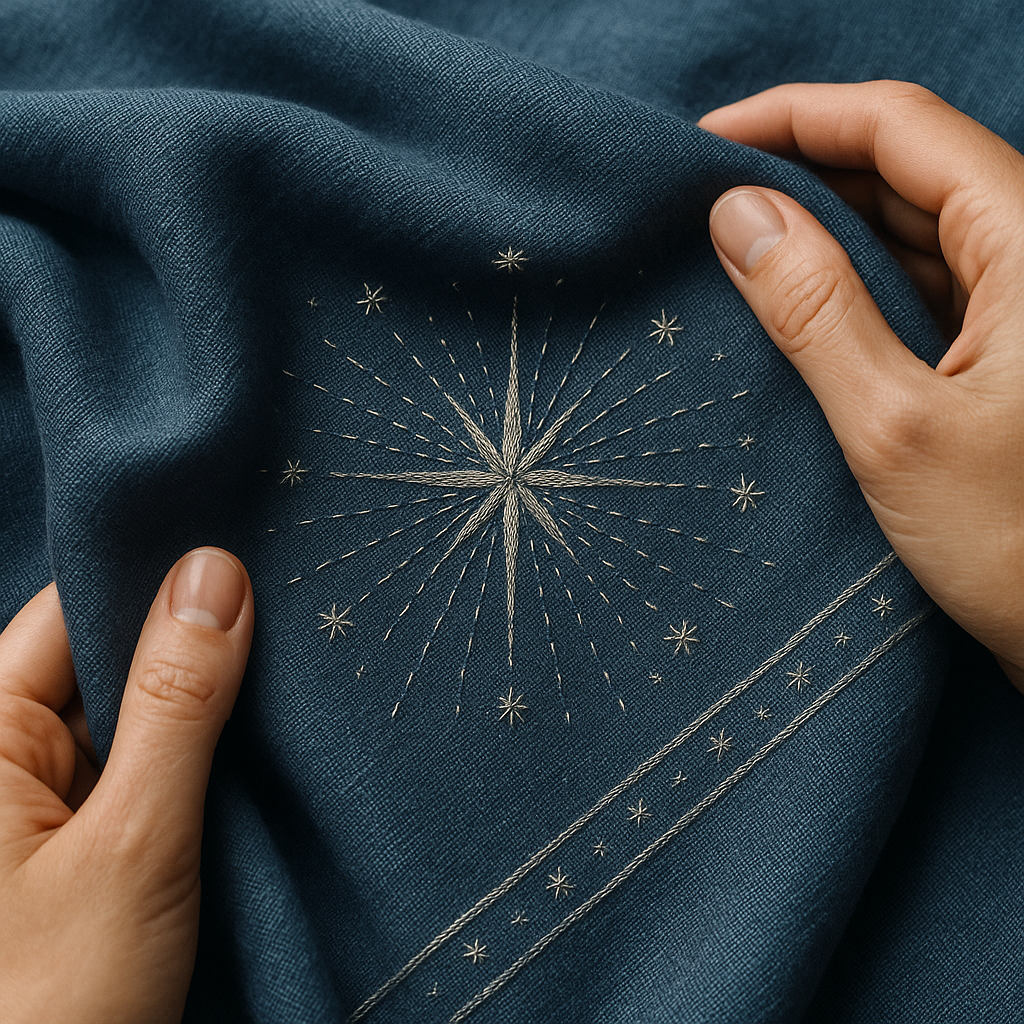
Farra is famed for its weaving — fabric fine enough to breathe like skin, often interwoven with silver thread and dyed in storm colours.
Though they lack growing land, Farra is where cloth becomes what it is meant to be. Flax grown on other islands arrives here as spun yarn, and the Farrans weave it on looms set close to shared hearths. Dyeing is a slow ritual: sea-weathered lichens, fermented dye vats, cloth soaked and stirred by storm-light. Finished fabric is strong and fine, often embroidered with silver thread and marked with signs for life events. It’s not mass work — it’s deliberate, careful, sometimes spiritual. A single family might work a bolt for weeks, and if the fire burns low, the cloth will wait.
Resources and Living
Farra is treeless and raw, shaped by wind and stone. The people burn dried peat, dung cakes, and driftwood hoarded like treasure. Seaweed is foraged for food and fuel, moss for insulation, and lichen for dye. Fuel is never wasted — heat is stored in stone, meals are cooked slow, and every fire is shared.
Architecture: The Hive Homes of Farra
Built from snug-fitted stone, most homes use barrel vaults or corbelled chambers, but unlike single-family dwellings, these are modular structures like a stone honeycomb, shared between families.
To maximise warmth, each home is constructed around a central chamber that is:
- Vaulted highest, with a communal hearth and low seating ledges around the walls.
- Used for meals, rituals, stargazing talk, dream-chanting, and dye planning.
- Warmest, best-lit, and spiritually charged — the heart of the household.
The central chamber always has carved motifs in its corners, traditionally: wind, star, circle, bird, and eye — but families may add their own.
Spokes lead outward to private chambers, work nooks, sleeping spaces, and storage vaults.
Each family has one or two rooms, but doors are textile-curtained, not barred — privacy is respected, not enforced.
There’s often a shared dye vat, drying racks, and a small stone loom bench tucked into a wind-shielded outer room.
Outside the main hive, there’s usually a sheltered sunken courtyard, part-natural, used for:
- Wet work (soaking, felting, dyeing).
- Stargazing platforms or offering stones.
- Drying cloth in calm weather.
Hive Variations
1. The Sixfold (Hexagon Cluster)
- Made up of six outer rooms and one inner hexagonal hearth room.
- The outer rooms are used for family quarters, storage, craft, and dyeing.
2. The Starfold (Pentagon Cluster)
- A pentagonal version of the Sixfold, but these are rarer, built for families with a legacy of seers or founders.
3. The Hillback Diamond
- A wide, diamond-shaped four-chamber home, with the topmost room built against the hillside, partially embedded.
- This top room is always the hearth space, backed by earth for warmth, with a flue carved directly through the stone and up through the slope.
- The other three rooms radiate downward and outward — living, working, and sleeping.
- Indented outer angles are filled with packed earth and stone from the excavation, giving these homes an almost naturalistic, grown-from-the-rock appearance.
Household and Social Structure
- 3–4 families per hive; each household is tight-knit and stable.
- As is the way on The Outer Winds, decisions are made communally, with everyone aged 12+ participating in house council. Roles rotate, and no one rules — power is fluid and based on trust, skill, and presence, not force or birth.
- Children are raised by all adults, not just their birth family — though kinship lines are still remembered.
- The homes are co-owned, and no member is evicted except in the rare case of spiritual breach (e.g., knowingly poisoning dye, disrupting rites, refusing to listen to dreams).
Spirituality and Mysticism
As with its cousin islands – Oskerra, Larne and Vey – Farra is deeply bound in spirituality. Being so exposed to the raw weather, it comes naturally to Farrans to read and respect the powerful forces around them. Important to them:
- Stargazing, dream-chanting, and dye rites form a woven worldview. The colour of a cloth can represent a story, a mood, or a star’s rising.
- The hearth is not just practical — it’s seen as a binding flame, fed with oils, herbs, or wool threads in rites.
- Some homes maintain a “Speaking Stone” — a lichen-covered boulder in the courtyard that acts as a scrying or grounding site.
- Work is never just work. Every step — from weaving to dyeing — is done with words, rhythm, or intention. Even cloth hung to dry might be arranged to “catch” dreams or omens.