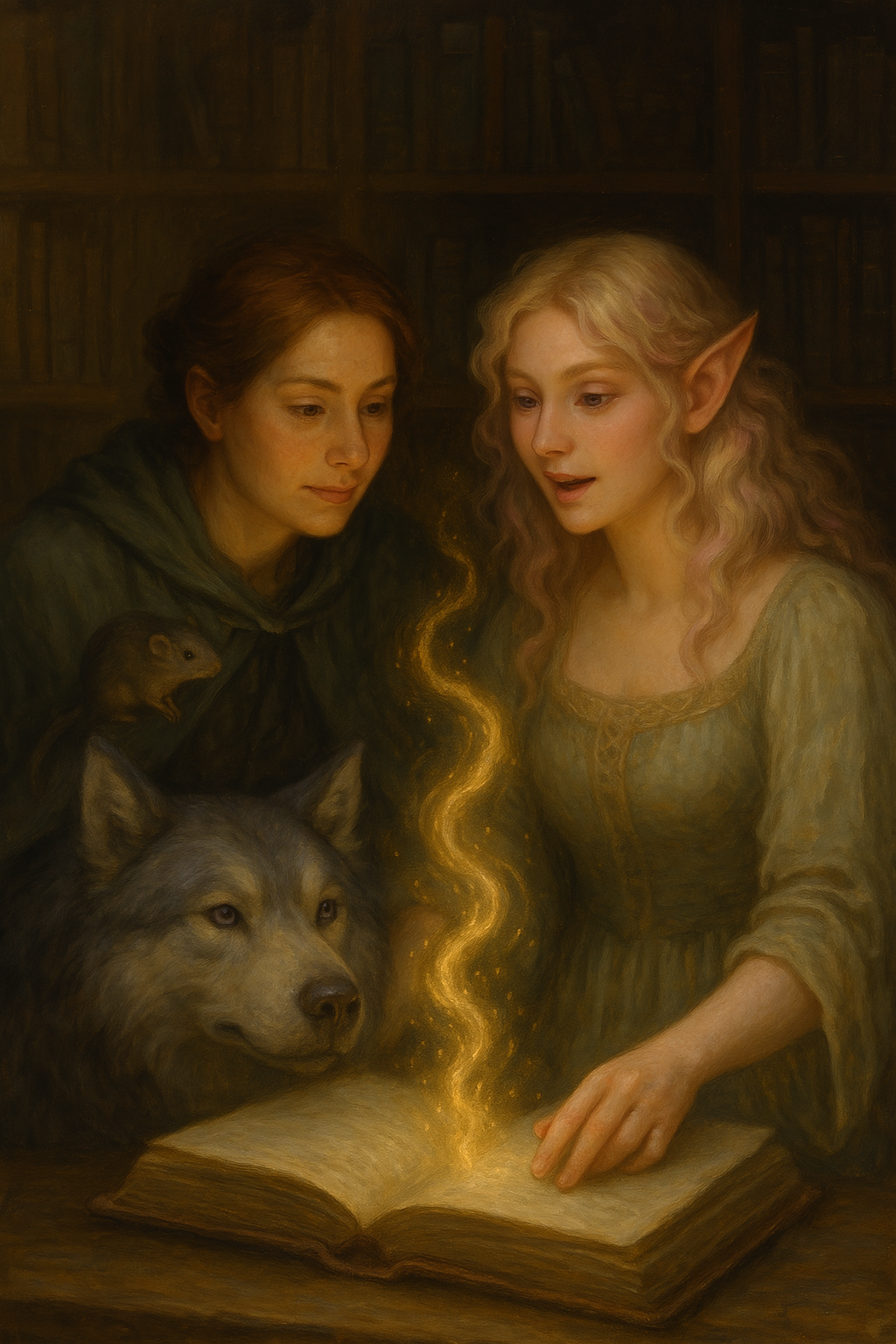
The room smelled of dust and rosemary.
They had pulled the ancient vellum scroll from a crumbling folio wedged behind a loose plank in the library shelves. No title. Just a faint mark scorched into the margin—an old glyph for beginning.
Gwynviène sat with the scroll unfurled across her lap, her fingertip hovering just above the faded ink. The page trembled slightly under her breath.
Lowen leaned in, careful not to disturb the parchment. Myrtle clung to their shoulder, sniffing the air as if the words themselves carried scent. Panvier lay beside them, unusually still, his pale lavender eyes fixed on the curling glow that had begun to rise softly from the page.
“It’s reacting to you,” Lowen murmured, not quite a question.
“No,” Gwynviène said, just as quietly. “To the story.”
She began to read, her voice soft, though almost reverent.
“Once, there was no difference between fae and elf, for they were the same: the Firstborn of the Wild World.
They were children of the river’s hum and the star’s first sigh. Their limbs held moonlight and their breath the rhythm of roots.
Where they walked, stories grew like moss. Where they wept, silver springs rose from stone. Their names were long and secret, and they passed like wind through bark and bone.
For an age, they sang with the world—not above it, not beside it, but within it.
But then came the Gilding, a hunger that first shimmered as wonder. One among them saw the way gold caught fire in sunlight and said,
‘This should be mine.’
Another pressed a leaf between pages and whispered,
‘Let no one else speak of this tree.’
And another still sold a song to a king for silver and silence.
Thus, the Evergild were born—those who chose name over nature, power over pattern.
They made Houses from what once were hearths, bound wind with coin, and called it law. They forgot the scent of soil, the song of the fern, the warmth of being unnamed.
Those who would not follow—the quiet-hearted, the rhythm-keepers, the dusk-watchers—turned away, retreating to grove and glade.
And so were elves born anew, not lesser, but left behind.
But the roots remember. Even cut, they ache toward each other.”
The glow pulsed brighter with each word, not harsh like fire, but soft and golden—like the last light through autumn leaves. As Gwyn spoke, the air filled with something deeper than magic. Memory, maybe. Or the ache of something forgotten remembering itself.
Lowen didn’t speak, but their expression shifted—eyes narrowing slightly in concentration, a breath caught in their chest.
—silence settled.
Gwynviène’s hand stayed resting on the scroll, her eyes still on the gently curling light. “I’ve read hundreds of stories,” she said. “But this… this feels like it’s been waiting.”
Lowen nodded, slow. “I think I’ve heard this before. Or… something like it. My father used to hum this tune by the fire when he thought I was asleep. It always made the night feel… bigger.”
They looked at her, truly looked.
“I think this was meant for both of us.”
Gwynviène didn’t reply. She just shifted the scroll slightly between them and whispered, “Then let’s remember it. Together.”