Folk say the Hax came over the sea eight centuries past, not in conquest but in kin-fleets of carved boats, their hulls packed with beans, peas, and sacks of grain. They hailed from a wooded peninsula, river-laced and marsh-edged, a landscape they carried in their very bones. They were not tall, but built square and sure: ruddy-skinned from wind, dark-haired, with arms that knew the axe and the adze.
They brought their ways with them — carving runes on beams and beads, tying meaning to the shapes of animals, humming low chants with their feet in flowing water. They were not mages, but symbolists; a serious folk, slow to laugh, steady in their work.
They built in wood, for that was their element: boats to trade and travel, windmills to claim the wind, bridges and walkways to span the water. A Hax village rose like a thicket of timber — alder frames, willow fuel, buildings with beams strong enough to last a millennium, uniform houses clustered around a central communal gathering place.
The First Settlements
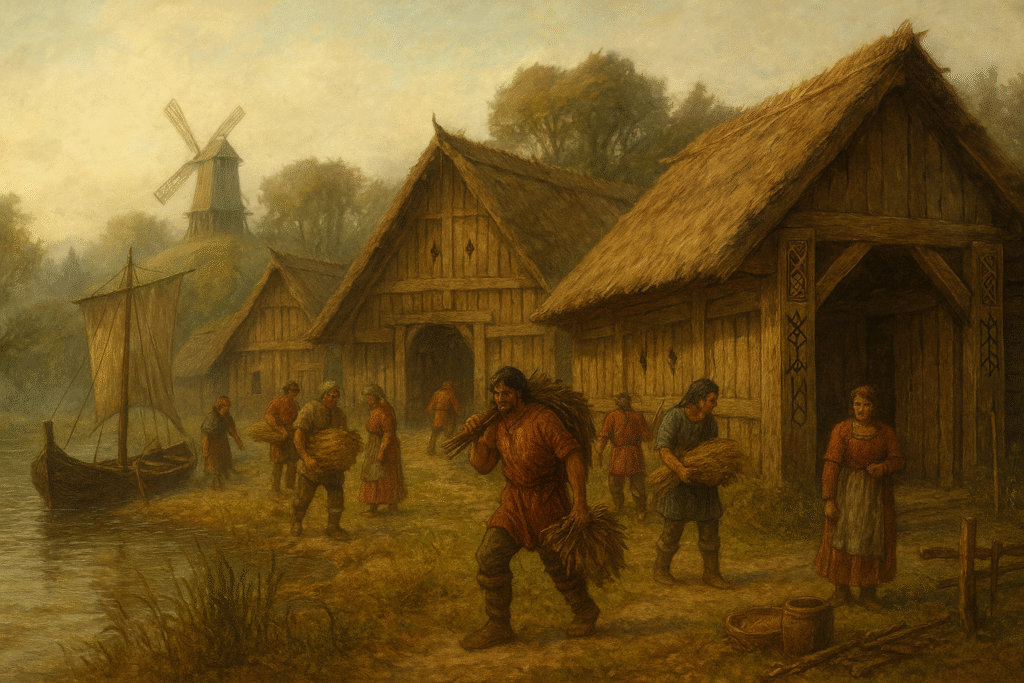
The Hax followed the rivers and their tributaries upstream, settling in a crescent along the coast. They raised a scatter of camps in the clearings — fishing-stations, timber-yards, seasonal hearths. In those days they were no more than clusters of longhouses with the boats drawn up beside them, though in time such camps would grow into villages.
Their first major settlement on Gildraen’s shore was Hasklon, set on the seam between fen-carr and drier ground. Then, it was a thriving place: a great timber hall with arching double doors, a wooden windmill groaning on the rise, boats moored by the riverbank. The carr was generous — fish, fowl, and firewood in plenty — and the Hax’s skill with timber made their settlement swift and stout.
But their ways troubled the locals. To hunt animals for meat was near unthinkable in those parts, yet the Hax did so without shame. To cut woodland was seen as presumption, yet the Hax cut with reverence, saying woods were not owned but tended. Their boat-villages unsettled those who rowed past: imagine drifting into a clearing and finding yourself eyed by strangers from the hearths of half-built halls.
Fear grew. There was skirmish and dispute. At last the Wisefolk were called to mediate, and after long talks a treaty was sworn: the Hax might remain, but spread no further inland. “Over Hasklon” became the phrase, a line scratched into law and memory — all that lay on higher ground was not theirs to take.
The Lost Place
Three centuries after their landing, the waters rose. The carr turned to fen — what folk now call Morthfen — and then to lake and reedbed. Hasklon stood ankle deep, and was regretfully abandoned. The Hax pulled back, some crossing the sea to their homeland, others slipping quietly into the woods inland. They did not trumpet their passage; they simply appeared elsewhere, as if the fens themselves had lifted them and set them down.
The name remained. Overhasklon became the whole region’s label, though few remember why. To most it is only a word. To the Hax, it is scar and story both.
After the Treaty
In time the Hax founded Little Hasklon, a woodland village built in honour of the lost one. It lay on a wooded hillside beside a rivered valley, with springs and a long narrow waterfall. Here their craft showed itself: carvings on lintels, archways on communal halls, even turret-like chambers sprouting above certain roofs. Little Hasklon became their jewel, proof they could build beauty as well as strength.
Today the Hax are more rumour than people. They are not often met, and few would think to ask after them. Yet in the woods of Overhasklon you may stumble on a village such as Haxthwaite, its folk serious and sturdy, trading by boat when they must, vanishing again into the trees when the deal is done.